Delhi’s air quality continued to remain in the ‘very poor’ category on Tuesday, with the city’s average air quality index (AQI) at 333 at 8 am, according to data from the Central Pollution Control Board (CPCB).
The Anand Vihar monitoring station reported an AQI of 386, up from Monday’s 327, reflecting persistently high pollution levels across the capital.
Most stations report ‘very poor’ air
At 8 am, a majority of Delhi’s monitoring stations were firmly in the ‘very poor’ bracket. Anand Vihar (386), Ashok Vihar (354), Bawana (392), Burari (364), Chandni Chowk (400), Dwarka Sector 8 (325), ITO (334), Patparganj (359), Rohini (355), Punjabi Bagh (356), and Vivek Vihar (399) are among the worst-hit areas. Many of these stations are approaching the ‘severe’ threshold of 400 AQI.
A few pockets recorded relatively better air quality in the ‘poor’ category, including IGI Airport (271), Lodhi Road (272), Mandir Marg (242), and NSIT Dwarka (222), providing only slight relief to residents.
Mumbai enforces GRAP Stage 4 curbs
Meanwhile, in Mumbai, air quality has also worsened, prompting the Brihanmumbai Municipal Corporation (BMC) to implement the strictest pollution control measures under the Graded Response Action Plan (GRAP-IV). The curbs target areas with ‘very poor’ to ‘severe’ AQI readings and include halting construction and enforcing dust-control measures, as residents continue to face health risks.
Delhi-NCR air chokes despite low farm fires
Even with farm fires at a multi-year low, Delhi-NCR’s air remains hazardous. For most of October and November, pollution levels hovered between ‘very poor’ and ‘severe’, driven by a combination of PM2.5, nitrogen dioxide (NO₂), and carbon monoxide (CO) from vehicles and other local sources.
A recent study by the Centre for Science and Environment (CSE) found that 22 air-quality monitoring stations in Delhi recorded CO levels above permissible limits on over 30 of the 59 days assessed. Dwarka Sector 8 logged the highest number of exceedances at 55 days, followed by Jahangirpuri and Delhi University’s North Campus at 50 days each.
The study also noted a sharp increase in pollution hotspots. In 2018, only 13 areas were officially designated as hotspots, but now several locations regularly report pollution levels far above the city average.
Limited improvement despite lower peak pollution
While peak pollution this year was lower compared with the last three winters, thanks to fewer firecrackers and reduced stubble burning, average air quality has seen almost no improvement. PM2.5 levels for October-November were around 9 per cent lower than last year, but relative to the three-year baseline, the change is negligible.
Weather conditions worsen air quality
Air-quality is expected to show little improvement in the coming week, as meteorological conditions continue to hinder the dispersal of pollutants. The India Meteorological Department (IMD) has forecast foggy conditions for Tuesday, with temperatures ranging between 9 degrees Celsius and 24 degrees Celsius, which could trap pollutants close to the ground.

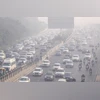 "Delhi air stays 'very poor' as over 30 stations record AQI above 300")

