Home / India News / Delhi air quality worsens to 'poor' after brief respite; AQI at 256
Delhi air quality worsens to 'poor' after brief respite; AQI at 256
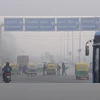
Early morning fog sharply reduced visibility across the capital, slowing traffic, while flights at IGI Airport operated under low-visibility protocols as the AQI remained in the poor category
The dense fog disrupted traffic and impacted aviation operations at Delhi’s Indira Gandhi International Airport (Photo:PTI)
2 min read Last Updated : Feb 03 2026 | 9:41 AM IST
Delhi residents woke up to dense fog on Tuesday morning, with visibility sharply reduced across several parts of the city. According to the Central Pollution Control Board (CPCB), the overall Air Quality Index (AQI) at 8 am stood at 256 in the ‘poor’ category.
Out of the 39 monitoring stations across Delhi, 17 recorded AQI in the poor range, 11 in the very poor range, and 10 in the moderate range.
Some of the highest readings were recorded in:
Chandni Chowk- 324
Wazirpur- 316
RK Puram- 300
Mundka- 297
Dwarka Sector 8- 293
Punjabi Bagh- 295
The AQI was the lowest at Lodhi Road, and was recorded to be 142.
As per AQI classification, a reading between 0 and 50 is 'good', 51 to 100 'satisfactory', 101 to 200 'moderate', 201 to 300 'poor', 301 to 400 'very poor' and 401 to 500 'severe'.
The fog follows an unusually cold Monday, when the city recorded its lowest February maximum temperature in four years at 17.5 degrees Celsius, nearly 5 degrees below normal. Early in the morning today, temperatures were around 12 degrees Celsius, according to the India Meteorological Department (IMD). Cold, moist northwesterly winds combined with high humidity to cause the persistent fog across Delhi and neighbouring areas.
The dense fog disrupted traffic and impacted aviation operations at Delhi’s Indira Gandhi International Airport. The airport issued a passenger advisory at 9 am, stating that flights were operating under CAT III conditions, which allow landings in very low visibility but may still cause delays.
Authorities have urged residents, particularly children, the elderly, and people with respiratory issues, to take precautions. Experts recommend limiting prolonged outdoor activity, wearing masks, and keeping windows closed to reduce exposure to pollution and cold.


 "Delhi air quality worsens to 'poor' after brief respite; AQI at 256")

