Train accidents surged 37% in FY23 despite Budget push for safety

Railway Board flagged grave safety issues in review meetings in April and May
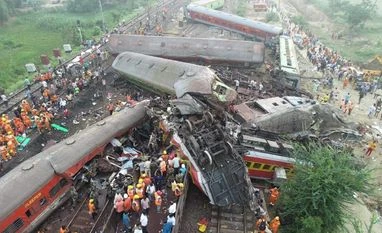
Odisha train crash
Odisha train crash
Dhruvaksh Saha New Delhi
5 min read Last Updated : Jun 03 2023 | 1:38 PM IST
The three-train collision in Odisha that left 275 dead and 803 injured is being seen as one of the worst accidents in independent India’s rail history, and has brought focus back on the lack of safety at the national transporter. Despite record budgetary allocations for infrastructure up­grade and safety, consequential rail accidents increased by 37 per cent in 2022-23. Many of these accidents in­vol­ved goods trains, with most not reporting casualties.

According to senior officials, a train accident is considered consequential in one or more of the three scenarios — total communications failure for over three hours after the accident (partial failure for six hours), value of damages over Rs 2 crore, and loss of life.

The data was shown in an official safety review meeting cond­ucted by the Ministry of Railways in April, the record of which was released to all railway zones on May 8. In the meeting, CEO and Chairman of Railway Board Anil Lahoti had flagged the rise in consequential accidents as a “matter of grave concern”, according to the minutes.

There were 48 consequential train accidents in FY23, as compared to 35 in the previous fiscal year, besides an alarming 35 incidents of signal passed at danger (SPAD). There were 162 non-consequential train accidents last fiscal, as compared to 208 in FY22.

Poor rolling stock maintenan­ce, lack of pointsmen, and long working hours of crew in several railway zones were found to be key factors leading to the increase in accidents.

In the above-mentioned review meeting with general managers of all zonal railways and heads of railway-owned undertakings, Lahoti had brought these issues up and directed officials to immediately take corrective measures.

“Focus needs to be kept on the quality of rolling stock maintena­nce, materials used for it, working practices, and tests, superchecks by officers,” the chairman noted at the meeting, as quoted in the official minutes. He also said that is­s­ues relating to track, signalling and operations, and “systemic deficiencies” must be addressed.

Union Minister for Railways Ashwini Vaishnaw, who is overseeing the rescue and restoration wor­ks at the accident site in Odi­sha, indicated an issue of points. “It is not an issue of Kavach, it’s an issue of points,” he told reporters on Sat­urday. Minutes of the April review meeting reveal that Lahoti had in­structed zonal railways to fill vac­ancies of pointsmen on priority in the upcoming recruitment.

A senior government official said that the lack of pointsmen has been a serious issue in rail operations, but it cannot be confirmed whether it was a contributing factor in the events that led to Friday’s accident as investigation is underway.

Meanwhile, the Railway Board also held meetings with several zonal branches over the issue of long working hours. Rail experts claim that shifts longer than 12 hours for crew directly involved in station, track and rolling stock operations are dangerous and must be avoided at all costs.

In one such meeting on May 17, the Railway Board cracked the whip on South East Central Rail­way (SECR), after it was found that 36 per cent of its crew had been working for over 12 hours a day since March. In the Bilaspur-Shahdol section, over 71 per cent of the crew was found working shifts of more than 12 hours in April, in what the board termed a gross violation of its policy, an official record of the meeting communicated by it to SECR said.

“These long hours of duty on a regular basis are a matter of grave concern. It grossly violates Board’s extant policy and can lead to very unsafe conditions. No perceptible improvement is noticed so far despite serious case of rear-end collision in this section on April 19,” the board had told SECR.

The SECR zone is right beside that of South Eastern Railway, which is where the accident took place. Officials said that zones in the coal belt were especially prone to the malaise of overworked emp­loyees as peak power demand makes coal movement a priority in the summer months.

The senior official quoted above, who spoke to Business Stan­dard on condition of anonymity, said overworked crew may have been a reality in SER, but in the operations of goods trains, not that of passenger trains. “Therefore, it’s unlikely that the issue of overworked crew can be blamed for the accident in Balasore.”

Meanwhile, the 35 cases of SPAD are a wor­r­­ying sign for the national transporter, as it contin­ues with the deployment of its indigenous anti-collision system, Kavach. The board flagged that the issue was persisting despite large-scale counselling of loco pilots. Kavach is designed to send an alert to loco pilots in cases of SPAD.

Railway Board spokesperson Amitabh Sharma on Friday said that the accident area had not been covered by the Kavach technology. Meanwhile, Railway Board Mem­ber Jaya Varma Sinha confirmed on Sunday the suspicion of many experts, that Kavach, too, would not have averted the accident.

In 2021, the national transporter boasted of a historic feat — no passenger deaths in train accidents in two years. However, the derailment of Bikaner-Guwahati Express in 2022 brought the Railways back to its forgetful past, as the accident left nine people dead and over 50 injured.

Several derailments were also found to be caused as a result of cattle being run over, underscoring the need for fencing of the railway network as it aims for a substantial speed upgrade on its tracks.


One subscription. Two world-class reads.

Already subscribed? Log in

Subscribe to read the full story →
*Subscribe to Business Standard digital and get complimentary access to The New York Times

Smart Quarterly

₹900

3 Months

₹300/Month

SAVE 25%

Smart Essential

₹2,700

1 Year

₹225/Month

SAVE 46%
*Complimentary New York Times access for the 2nd year will be given after 12 months

Super Saver

₹3,900

2 Years

₹162/Month

Subscribe

Renews automatically, cancel anytime

Here’s what’s included in our digital subscription plans

Exclusive premium stories online

  • Over 30 premium stories daily, handpicked by our editors

Complimentary Access to The New York Times

  • News, Games, Cooking, Audio, Wirecutter & The Athletic

Business Standard Epaper

  • Digital replica of our daily newspaper — with options to read, save, and share

Curated Newsletters

  • Insights on markets, finance, politics, tech, and more delivered to your inbox

Market Analysis & Investment Insights

  • In-depth market analysis & insights with access to The Smart Investor

Archives

  • Repository of articles and publications dating back to 1997

Ad-free Reading

  • Uninterrupted reading experience with no advertisements

Seamless Access Across All Devices

  • Access Business Standard across devices — mobile, tablet, or PC, via web or app

Topics :Odisha Train Accidenttrain collisionTrain Crash

Next Story


