Home / India News / Developed economy should also be developed ecology: Environment minister
Developed economy should also be developed ecology: Environment minister
Human-centric approach to development is insufficient, he said, speaking at an event at the Indian Institute of Technology (IIT) Bombay -- Ideas4LiFE - Lifestyle for Environment'
Ideas4LiFE - Lifestyle for Environment' has been organised in collaboration with the Maharashtra Environment Department. | File photo
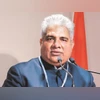
Union Minister for Environment, Forest and Climate Change Bhupender Yadav on Saturday said there is a need to balance economic development of the country with ecology, as both are interconnected.
Human-centric approach to development is insufficient, he said, speaking at an event at the Indian Institute of Technology (IIT) Bombay -- Ideas4LiFE - Lifestyle for Environment' -- that aims to inspire innovative environmental solutions.
"A developed economy should be a developed ecology too....there is interconnectedness between all life forms. Life extends beyond human needs, therefore, there should be harmonious coexistence of all living beings and the environment," the minister said.
Ideas4LiFE - Lifestyle for Environment' has been organised in collaboration with the Maharashtra Environment Department to engage students, faculty and researchers nationwide in generating ideas promoting an eco-friendly lifestyle. The minister further urged students to embrace environmental consciousness, and said, "We should be citizens with environmental sense."
Human-centric approach to development is insufficient and instead there is a need for an "ecologically conscious model", Yadav added.
Around 50,000 species are used for human consumption, he said, underlining the importance of preserving at least one-third of the Earth for biodiversity. The Indian government, he said, has accomplished its renewable energy targets nine years ahead of schedule, and introduced the Soil Health Card initiative to reduce the use of chemicals in agriculture. Talking about food waste, Yadav said 15 billion tonnes of food is sent to landfills each year, and invited ideas and suggestions from the students for preserving nature and reducing waste.
Tanmay Kumar, special secretary, Ministry of Environment, Forests and Climate Change, said on the occasion that climate change is a big challenge and it results in loss of life, loss of habitation and loss of livelihoods. He urged students, researchers and scholars to join hands with the government, policy-makers and administrators to influence policy- making.
"We are urging the student community, faculty, and the research scholars to contribute to this concept of getting into the sustainable lifestyle, how do we adopt an environmentally friendly lifestyle in our day-to-day existence," he added.
(Only the headline and picture of this report may have been reworked by the Business Standard staff; the rest of the content is auto-generated from a syndicated feed.)

 "Developed economy should also be developed ecology: Environment minister")


 Connect with us on WhatsApp