
Greenland glaciers melting 3 times faster than 20th Century: Research
There has been widespread and intense mass loss of glaciers and ice caps in Greenland at a rate that is three times faster than seen in the 20th Century, finds an alarming study
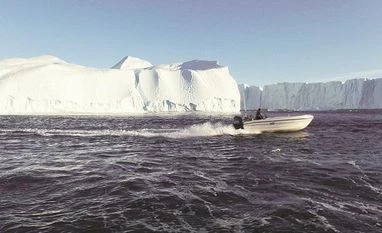 "Greenland glaciers melting 3 times faster than 20th Century: Research")
Explore Business Standard
There has been widespread and intense mass loss of glaciers and ice caps in Greenland at a rate that is three times faster than seen in the 20th Century, finds an alarming study
There has been widespread and intense mass loss of glaciers and ice caps in Greenland at a rate that is three times faster than seen in the 20th Century, finds an alarming study.
The research provides critical insights into long-term changes to the country's glaciers and ice caps as a result of climate change, which has contributed about one fifth to global sea-level rise in the last decade.
Using historical data, scientists mapped 5,327 glaciers and ice caps that existed at the end of the Little Ice Age in 1900; a period of wide-spread cooling when average global temperatures dropped by as much as 2 degrees Celsius. They were then able to reveal these fragmented into 5,467 by 2001.
The study, published in Geophysical Research Letters, showed that Greenland's glaciers have lost at least 587 cubic kilometres (km3) of ice over the last century, accounting for 1.38 millimetres of sea-level rise.
That equates to 499 gigatons (Gt) at an alarming rate of 4.34 Gt per year; enough to fill 43,400 US aircraft carriers.
It estimates the speed at which the water melted between 2000 and 2019 was three times higher than the long-term (since 1900) average, the researchers said.
"It's also important to note, that we only looked at glaciers and ice caps that were at least 1 km in area, so the overall amount of ice that has melted would be even more than our predictions if you take into account the smaller ones," said Dr Clare Boston, School of the Environment, Geography, and Geosciences at the University of Portsmouth
The study stresses the importance of understanding these changes in the context of global sea-level rise.
Greenland's glaciers and ice caps contribute significantly to meltwater runoff and currently rank as the second-largest source of meltwater, after Alaska.
"The impact of meltwater runoff from Greenland into the North Atlantic extends beyond global sea-level rise, affecting North Atlantic ocean circulation, European climate patterns, and Greenlandic fjord water quality and marine ecosystems," said lead author Dr Jonathan L. Carrivick from the School of Geography at University of Leeds.
"This has immense implications on humans too, with these glacier changes having a direct impact on the economic activities of fishing, mining, and hydropower, as well as affecting people's health and behaviour."
--IANS
rvt/dpb
(Only the headline and picture of this report may have been reworked by the Business Standard staff; the rest of the content is auto-generated from a syndicated feed.)
First Published: May 30 2023 | 4:15 PM IST


