
India, Australia aim to conclude comprehensive trade deal by end of 2023
In his media statement, Albanese said the aim is to conclude the comprehensive economic cooperation agreement (CECA) by the end of the year
 "India, Australia aim to conclude comprehensive trade deal by end of 2023")
Explore Business Standard

Associate Sponsors
Co-sponsor
In his media statement, Albanese said the aim is to conclude the comprehensive economic cooperation agreement (CECA) by the end of the year
India and Australia on Wednesday inked a migration and mobility partnership pact to open up opportunities for students, academic researchers and business people and resolved to conclude a comprehensive trade deal by the end of year to significantly expand economic ties.
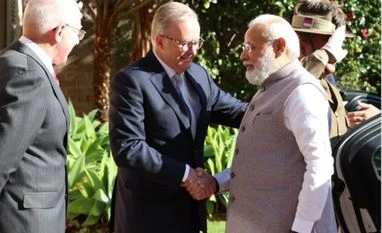
The pact was signed after wide-ranging talks between Prime Minister Narendra Modi and his Australian counterpart Anthony Albanese.
In his media statement, Albanese said the aim is to conclude the comprehensive economic cooperation agreement (CECA) by the end of the year.
"We reiterated our shared ambition for an early conclusion of the Australia-India comprehensive economic cooperation agreement later this year," he said in the presence of Modi.
Last year, India and Australia finalised the Economic Cooperation Trade Agreement (ECTA) and it came into force in December last. The two sides are now working on the CECA.
"Today, in my meeting with Prime Minister Albanese, we talked about taking India-Australia Comprehensive Strategic Partnership to greater heights in the next decade," Modi said.
"We discussed in detail the possibilities of cooperation in new areas. Last year India-Australia ECTA came into effect. Today we have decided to focus on CECA -- Comprehensive Economic Cooperation Agreement," he said.
Modi said the pact will give further strength and new dimensions to trade and economic cooperation between the two countries.
"We had constructive discussions on strengthening our strategic cooperation in the sectors of mining and critical minerals. We have identified concrete areas for cooperation in renewable energy," Modi said.
"It was decided to set up a task force on Green Hydrogen," he added.
Foreign Secretary Vinay Kwatra said the next two rounds of talks on the economic partnership pact have been scheduled for June and July.
Modi and Albanese also witnessed the signing of the terms of reference of the Australia-India Green Hydrogen Taskforce which will explore opportunities in the area of renewable hydrogen.
"Renewable energy was once again a focus and an important topic in our discussions," Albanese said.
On the migration and mobility pact, Albanese said it will promote the exchange of students, graduates, researchers and business people; expand our people-to-people ties and enhance cooperation in "preventing people smuggling".
The Ministry of External Affairs (MEA) said Modi and Albanese welcomed the signing of the Migration and Mobility Partnership Arrangement (MMPA).
It said the MMPA will further facilitate mobility of students, professionals, researchers, academics and others, including through a new skilled pathway named MATES (Mobility Arrangement for Talented Early Professionals Scheme) specifically created for India.
It said they also welcomed the finalisation of terms of reference of the India-Australia Hydrogen taskforce.
The taskforce will advise on opportunities to accelerate manufacture and deployment of clean hydrogen, focusing on hydrogen electrolysers, fuel cells as well as supporting infrastructure and standards and regulations.
In his remarks, Modi also highlighted the importance of India-Australia relations for the region.
"The scope of India-Australia relations is not limited to merely our two countries. It is also linked to regional stability, peace and global welfare," he said.
"A few days ago, along with Prime Minister Albanese, at the Quad Summit in Hiroshima, we also discussed the Indo-Pacific. India-Australia cooperation can also be beneficial for the progress of the Global South," Modi said.
He said the Indian tradition of "Vasudhaiva Kutumbakam, which sees the whole world as one family, is the central theme of India's G-20 Presidency."
The prime minister described his meeting with Albanese as "constructive".
(Only the headline and picture of this report may have been reworked by the Business Standard staff; the rest of the content is auto-generated from a syndicated feed.)
First Published: May 24 2023 | 8:18 PM IST

