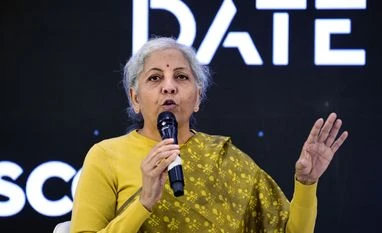
Finance Minister Nirmala Sitharaman on Monday said that Prime Minister Narendra Modi will come back to power in 2024 with a "good majority" and global investors need not be "jittery".
She also said the government is committed to systemic reforms to accelerate the pace of growth.
Participating in a debate virtually organised by India Global Forum, she said, investors "need not be jittery at all" about the outcome of general elections due in April-May 2024.
"...keeping their (investors) fingers crossed is normal and I can understand that. But here I am and also there are several people who are observing the Indian economy, observing the political environment, observing the ground level realities and the situation as it prevails today, Prime Minister Modi is coming back and coming back with a good majority," she emphasised.
The government led by Prime Minister Narendra Modi has taken various initiatives that have transformed the life of every Indian and the business environment has improved.
So, she said, "It is not as if this government has worked for one and not for the other. It has worked for everybody."
On the employment front she said the government is committed to providing 10 lakh jobs to youth of the country by December this year through Rojgar Mela held every month.
Out of this, she said, about 8 lakh have already been provided by the central government so far this year.
Talking about climate action, the Finance Minister said India is pushing forward on that with its own funds.
"The Paris commitment given by us has been funded by us. We didn't wait for the USD 100 billion that is never on the table...a lot of talk but no money coming ... no pathway to show how technology is going to be transferred," she said.
An additional issue is transition from fossil fuel to clean energy is going to be a challenge, particularly for developing and emerging market economies in terms of funding transition.
Asked about the impact of the ongoing conflict in Israel and Gaza on India-Middle East-Europe Connectivity Corridor (IMEC), she said, it is a long-term project and it is not going to be dependent on one or the other major event.
So it's going to face challenges due to some event or other but it has got its own strength, she said, adding, that countries who are directly or indirectly in connection with this project are absolutely clear that it is going to be critical for global trade, global partnerships.
The IMEC was signed at the 18th G-20 Summit held in New Delhi in September. It is a multimodal economic corridor that incorporates multiple networks of shipping, railways, and roadways and will also include electricity cables, high-speed data cables, and a hydrogen pipeline.
The corridor is expected to create a reliable and cost-effective cross-border, ship-to-rail transit network to supplement existing maritime and road transport, and facilitate trade and connectivity, leading to the economic integration of South Asia, West Asia, Europe, and the Middle East.
The IMEC will connect Indian ports such as the Jawaharlal Nehru Port Authority, Mundra (Gujarat), and Kandla (Gujarat), with West Asian ones such as Fujairah, Jebel Ali, and Abu Dhabi in the UAE, and Saudi Arabian ports of Dammam, Ras Al Khair, and Ghuwaifat.
Then there is a rail segment that will continue the IMEC and provide connection to the Saudi Arabian cities of Haradh and Al Haditha, onward to the port of Haifa in Israel.
The final segment, which some call the Northern Corridor, will once again be a maritime segment connecting the port of Haifa to the Greek port of Piraeus and there to Europe.

 "Investors need not be jittery; Modi coming back with majority: Sitharaman")


