
Justice Sanjiv Khanna to be sworn in as the 51st CJI on November 11
President Droupadi Murmu will administer the oath of office at Rashtrapati Bhavan in a ceremony scheduled at 10 am
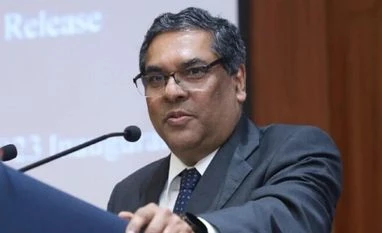 "Justice Sanjiv Khanna to be sworn in as the 51st CJI on November 11")
Explore Business Standard
President Droupadi Murmu will administer the oath of office at Rashtrapati Bhavan in a ceremony scheduled at 10 am
Justice Sanjiv Khanna, who has been part of several landmark Supreme Court judgements such as scrapping the electoral bonds scheme and upholding abrogation of Article 370, will be sworn in as the 51st Chief Justice of India on Monday.
President Droupadi Murmu will administer the oath of office at Rashtrapati Bhavan in a ceremony scheduled at 10 am.
Justice Khanna will succeed Justice DY Chandrachud, who retired on Sunday, and his term will last until May 13, 2025.
The Centre officially notified Justice Khanna's appointment on October 24 following Chief Justice Chandrachud's recommendation on October 16. Friday was the last working day of Justice Chandrachud as the CJI and he was given a rousing farewell by judges, lawyers and staff of the apex court and the high courts.
Justice Khanna, who served as a Supreme Court judge since January 2019, has been part of several landmark judgements such as upholding the sanctity of EVMs, scrapping the electoral bonds scheme, upholding the abrogation of Article 370 and the grant of interim bail to former Delhi CM Arvind Kejriwal.
Hailing from an illustrious Delhi-based family, Justice Khanna is the son of former Delhi High Court judge Justice Dev Raj Khanna and the nephew of prominent former apex court judge H R Khanna.
Justice Sanjiv Khanna, who was elevated as a judge of the Supreme Court on January 18, 2019, was a third-generation lawyer before being appointed as judge of the high court. He is driven by the zeal to reduce pendency and speed up justice delivery.
Justice H R Khanna, the uncle of Justice Khanna, hit the headlines by resigning in 1976 after he wrote a dissenting verdict in the infamous ADM Jabalpur case during the Emergency.
The majority verdict of a Constitution bench, upholding the abrogation of fundamental rights during the Emergency, was considered a "black spot" on the judiciary.
Justice H R Khanna declared the move unconstitutional and against the rule of law and paid a price as the then central government superseded him and made Justice M H Beg the next CJI.
Justice H R Khanna was part of the landmark verdict propounding the basic structure doctrine in the Kesavananda Bharati case of 1973.
Among the notable judgments of Justice Sanjiv Khanna in the Supreme Court is upholding the use of electronic voting machines in elections, saying the devices were secure and eliminated booth capturing and bogus voting.
A bench headed by Justice Khanna, on April 26, termed the suspicion of manipulation of the EVMs "unfounded" and rejected the demand for reverting to the old paper ballot system.
He was also part of the five-judge bench that declared the electoral bond scheme, meant for funding political parties, as unconstitutional.
Justice Khanna was a part of the five-judge bench, which upheld the Centre's 2019 decision abrogating Article 370 of the Constitution which granted a special status to the erstwhile state of Jammu and Kashmir.
It was the Justice Khanna-led bench, which for the first time, granted interim bail to Kejriwal, the then chief minister, till June 1 to campaign in the Lok Sabha elections in the excise policy scam cases.
Born on May 14, 1960, he studied law at the Campus Law Centre of Delhi University.
Justice Khanna was the executive chairman of the National Legal Service Authority (NALSA).
He enrolled as an advocate with the Bar Council of Delhi in 1983 and initially practised in the District Courts at the TisHazari complex here and later, in the Delhi High Court.
He had a long tenure as the senior standing counsel for the Income Tax Department. In 2004, he was appointed as the standing counsel (Civil) for the National Capital Territory of Delhi.
Justice Khanna had also argued in a number of criminal cases at the Delhi High Court as an additional public prosecutor and as an amicus curiae.
(Only the headline and picture of this report may have been reworked by the Business Standard staff; the rest of the content is auto-generated from a syndicated feed.)
First Published: Nov 10 2024 | 4:27 PM IST


