
Farmers to be trained in modern technology to boost silk production in J&K
The High Yielding Silkworm hybrids and improved mulberry varieties have been developed by CSR and TI Pampore to increase the farmers' income through Sericulture
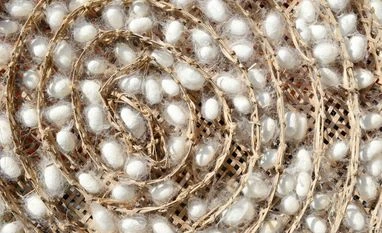 "Farmers to be trained in modern technology to boost silk production in J&K")
WebinarsNew
Deep DiveNew
Explore Business Standard
The High Yielding Silkworm hybrids and improved mulberry varieties have been developed by CSR and TI Pampore to increase the farmers' income through Sericulture
The Jammu and Kashmir government said on Monday that to boost silk production in the UT, farmers will be trained in using modern technology.
An official said, "The Jammu and Kashmir government is working under a multi- pronged strategy towards revival and holistic development of the Sericulture sector in the Union Territory.
"Cocoon growers are being facilitated with requisite skill development training, latest technological interventions and related infrastructural support for transforming the sericulture industry in J&K.
"The futuristic roadmap for holistic growth of agriculture and allied sectors will help in ensuring product quality and quantity besides raising global demand.
"The government is working on area expansion under mulberry plantations to increase leaf availability for rearers and to enrich green wealth.
"The Forest and Sericulture Departments are jointly working towards achieving J&K's Green Mission besides ensuring marketing support to the cocoon growers in selling their produce in their vicinity."
Lt. Governor Manoj Sinha also said during a function, "Our prime objective is to better the lives of farmers associated with this dream fabric besides ensuring uniqueness, beauty and ingenuity of J&K's crafts dominate the global market".
The official added that the futuristic roadmap for holistic growth of agriculture and allied sectors will safeguard the age-old skills being transferred from generation to generation.
"The effort is aimed at helping preserve and promote the unique and indigenous craft legacy of J&K across the globe.
"The government is giving importance to adoption of latest technological advancements in the silk industry to reduce dependence on imported silk. One of the three important centers in the country for Research and Development, Training, Transfer of Technology and IT Intervention has been set up at Kashmir's Pampore.
"Recently, the Department of Sericulture, Rajouri, Mulberry Circle Lamberi organised Kissan Ghosti/Scientific interaction under ATMA programme. The main objective of the programme was to educate silkworm rearers about the latest technology and practice for silkworm rearing.
"The farmers were briefed about various projects being implemented under Holistic Agriculture Development Programme."
In a significant accomplishment, Kundan Lal, a progressive farmer of Lamberi Rajouri, has earned Rs 91,666.50 in 20 to 25 days by selling 87.6 kg dry crop. Similarly, Tilak Raj of Lamberi Village of Rajouri has earned Rs 1,32,356 in 20 to 25 days by selling 131.350 kg of silk.
The official further said, "To cater to the research, training and extension needs of Jammu & Kashmir, the Central Silk Board (CSB) has set up the Central Sericulture Research and Training Institute (CSR & TI) at Pampore, Srinagar, in 1994 to revive earlier activities of the CSB in J&K.
"The institute is actively involved in Research and Development besides human resource development through its network of two Regional Sericulture Research Stations (RSRS) and 8 Research Extension Centers."
The High Yielding Silkworm hybrids and improved mulberry varieties have been developed by CSR and TI Pampore to increase the farmers' income through Sericulture.
"The Central Silk Board is promoting bivoltine production program extending technical support through six clusters (including two mega clusters) besides extending state of the art soil testing facilities. Due to the continuous efforts of the Institute and technological interventions, the average yield of bivoltine cocoons has been enhanced significantly.
"Notably, the Silk Samagra Yojana launched in 2017-18 under the guidance of PM has proved to be a game changer in making sericulture sustainable by supporting country's as well as J&K's silk industry in an integrated manner.
"Under Silk Samagra Phase-I, about 900 silkworm rearers have been benefited directly besides establishment of about 618 rearing houses. Besides, the Central Silk Board has allocated Rs 35 crore for J&K under Silk Samagra Phase-II benefitting around 27,000 families involved in Sericulture in the UT," the official said.
--IANS
sq/dpb
(Only the headline and picture of this report may have been reworked by the Business Standard staff; the rest of the content is auto-generated from a syndicated feed.)
First Published: Mar 27 2023 | 5:17 PM IST


 Connect with us on WhatsApp