Rashtriya Swayamsevak Sangh (RSS) chief Mohan Bhagwat on Thursday flagged the inadequacies of the prevalent global economic system, and pointed to the stiff tariffs by the United States on goods from other countries among one of its ramifications.
He was addressing the annual Vijayadashmi rally of the RSS, which also marked the centenary of its inception, near the organisation’s headquarters in Nagpur.
Bhagwat said that while no country can survive in isolation in a world that is acutely interconnected and interdependent, India should pursue self-reliance to ensure that its interdependence with the world is out of choice and not compulsion.
In the context of the US tariffs, the RSS chief said there was no substitute to embracing swadeshi, and swavalamban, or self-reliance.
In his address, Bhagwat spoke on an array of issues, such as the alarming environmental degradation and the need to save the Himalayas, the lessons India has learnt from Operation Sindoor, and expressed concern at the “anarchic” anti-government protests in India’s neighbourhood in recent times -- in Sri Lanka, Bangladesh, and Nepal.
On India’s military conflict with Pakistan, and Operation Sindoor, Bhagwat said the episode taught the country that it needs to be stronger and more vigilant about its security. Post the Pahalgam terror attack and Operation Sindoor, the responses of other countries were a test of “who our friends are in the global arena and to what extent they are willing to stand by us,” Bhagwat said.
At the event, where former President of India Ram Nath Kovind was the chief guest, the RSS chief lauded India’s economic growth as measured by conventional indicators, but said the prevalent global economic system led to increasing disparity and concentration of wealth and economic power, and could lead to devising of newer ways of exploitation, including of resources. He bemoaned the inhumane nature of the economic growth, which has engendered the unfortunate growth of transactional nature in human relationships.
“We will need to reconsider our approach on some issues to ensure that these flaws and the tariff policy adopted by America, based solely on its self-interest, do not pose a challenge for us,” Bhagwat said.
He cautioned about the rampant environmental degradation as a result of the global “materialist and consumerist development model”. The current development model, based on a “materialist and compartmentalised approach”, is directly linked to recent ecological disasters, unpredictable and excessive rainfall, landslides, natural calamities, and drying up of Himalayan snow-fed rivers. The Himalayas are the primary water source for the region, and we need to hear the warning bells to take measures to protect them, the 75-year-old RSS chief said.
Bhagwat said the Hindu society is an inclusive one, and it is and will remain free from the “us and them” mentality. He urged citizens not to disrespect the beliefs, icons, or places of worship of others.
“According to Bharatiya traditions, all are welcome....We look at them as ours rather than as the ‘other’.” But distinct identities “should not cause division”, he said. Bhagwat criticised the tendency to “take the law into one's hands” or engage in violence for trivial reasons. A “show of strength is deliberately done to provoke a particular community” and falling into such traps has evil consequences, he warned.
Bhagwat said the government should operate in accordance with law and without bias, and called for the “good people of society” and younger generation to remain vigilant, intervening when necessary to maintain social order. On the turmoil in India’s neighbourhood, which he said were “parts of Bharat” till some years back, Bhagwat identified the discontent as “disconnect between the government and society and lack of able and people-oriented administrators”.
The RSS chief said B R Ambedkar had described such protests as “grammar of anarchy”, and such violence has historically failed to bring any fundamental change, and warned that dominant powers of the world would try to find opportunities to play their own games.
“The regime changes in Sri Lanka, Bangladesh, and more recently Nepal due to violent outburst of public anger is a concern for us. The forces wanting to create such disturbances in Bharat are active inside as well as outside our country,” he said.

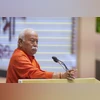 "No substitute for self-reliance: RSS chief Mohan Bhagwat on US tariffs")


