Tata Motors targets 20-25% SUV share with new Sierra: MD & CEO Chandra

Eyes doubling EV volumes in FY26
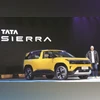
Tata Motors Passenger Vehicles MD & CEO Shailesh Chandra says the Sierra has been positioned between mid and high SUVs
Anjali Singh Mumbai
5 min read Last Updated : Nov 25 2025 | 11:35 PM IST
Tata Motors Passenger Vehicles is aiming to sharply increase its sport utility vehicle (SUV) market share from the current 16-17 per cent to as much as 20-25 per cent with the launch of the new Sierra, a model that Managing Director and Chief Executive Officer (MD&CEO) Shailesh Chandra says will carve out a fresh niche between mid- and high-SUVs.
 
The company believes Sierra’s design, premium positioning, and aggressive introductory pricing starting at ~11.49 lakh will give Tata a strong foothold in one of the fastest-growing segments.
 
Chandra said the Sierra has been deliberately positioned in the heart of the fast-growing mid-SUV category, a segment that now sells about 45,000 units a month, and accounts for nearly 15 per cent of India’s passenger vehicle (PV) market. Despite its scale, this remained a “discontinuity” in Tata Motors’ portfolio, with Curvv addressing only a niche, style-driven customer set rather than the broader utility-focused mid-SUV buyer.
 
India’s SUV market hit a new peak in 2024-25 (FY25), with total wholesales reaching 2.79 million units. Hyundai Creta, Mahindra Scorpio, and Tata Nexon are top performers in the segment.
 
“Sierra is not a me-too product in the mid-SUV segment,” he said, noting that the model has been conceptualised as a premium mid-SUV that stands apart through its design and the legacy of the original Sierra. “It occupies a very different space, it carries forward an icon while offering a completely modern interpretation,” he added.
 
Calling the Sierra’s market entry an “emotional moment” for Tata Motors, Chandra said the model fuses the original icon’s DNA with modern design and technology to appeal across generations, from GenX to GenZ. The company expects the Sierra to expand the segment itself, much like the Nexon did in compact SUVs, by drawing buyers who currently toggle between mid-size, high-SUV, and lifestyle-SUV options.
 
“The consumer doesn’t segment the vehicle the way the industry does; they look at choices around their budget,” he said, adding that Sierra’s distinctiveness, comfort, and footprint are likely to attract customers from adjacent segments, including Thar- and Jimny-style lifestyle SUVs.
 
The Sierra launches with three ICE (internal combustion engine) powertrains — two petrol and one diesel — while the electric vehicle (EV) version will arrive in the next financial year. Chandra said Tata expects the Sierra EV to play a significant role in accelerating electric penetration in the high-SUV category, thanks to factors such as improved range, fast charging, and price parity versus automatics in the ICE segment.
 
The company is already seeing the impact of a stronger EV portfolio, with industry penetration rising from 2.5 per cent to 5.5 per cent in a year, and Tata’s own monthly EV volumes increasing from 5,000 units last year to around 9,000 units now.
 
Chandra said he expects Tata Motors' EV volumes to double in FY26, supported by new models, widening consumer acceptance, and ecosystem improvements. While he declined to specify the expected EV-ICE split for Sierra, he noted that Harrier EV bookings had already surpassed its ICE counterpart, a trend that could possibly repeat with Sierra.
 
On the financial front, the Sierra is expected to strengthen Tata Passenger Vehicles’ margins from year one. “When you step into bigger cars, your mix becomes richer, so it will be favourable to Ebitda (earnings before interest, taxes, depreciation, and amortisation),” Chandra said, adding that the company continues to gain from aggressive cost-reduction initiatives, innovations in cell technology and power electronics, and better economies of scale.
 
The model will be manufactured at the upcoming Sanand 2 plant, part of Tata’s 900,000-unit annual PV capacity. The company, which is targeting 18-20 per cent of overall PV market share, and expanding its addressable market to 80 per cent, is also preparing Sierra for exports, with South Africa identified as a natural fit among right-hand-drive markets.
 
Chandra said he is not concerned about intensifying competition in the EV space, arguing that more players will expand the category and ultimately benefit Tata by increasing consumer confidence. The company aims to stabilise its EV market share at 45-50 per cent in the long term, even as volumes grow. “As long as we grow penetration and maintain healthy leadership, market share fluctuations are not a concern,” he said.
 
With double-digit industry growth expected in the second half of 2025-26 (H2FY26), Tata Motors is placing a strategic bet on Sierra to widen its SUV presence, and set the stage for a stronger EV run in the years ahead.
 
Setting a new safety benchmark, a high-severity head-on crash test was conducted to assess the Sierra’s structural performance and occupant protection in a realistic vehicle-to-vehicle collision scenario common on Indian roads. In a 50 kilometre per hour (kmph) offset impact involving adult and child dummies, the vehicle maintained cabin integrity, kept injury levels within prescribed limits, and its restraint and post-crash safety systems functioned as intended. The test was designed to evaluate performance beyond standard regulatory or NCAP (new car assessment programme) conditions.
 
“In a real-world crash, both vehicles are moving. Doors should open, people should be rescued, and injury criteria should remain within limits. Our car is meeting all of that. Our car-to-car crash test is not part of any regulation today, not even Global NCAP or Bharat NCAP,” said Mohan Savarkar, chief product officer of Tata Motors Passenger Vehicles.
 
Booking for Sierra will open on December 16, and deliveries will begin from January 15, 2026.

One subscription. Two world-class reads.

Already subscribed? Log in

Subscribe to read the full story →
*Subscribe to Business Standard digital and get complimentary access to The New York Times

Smart Quarterly

₹900

3 Months

₹300/Month

SAVE 25%

Smart Essential

₹2,700

1 Year

₹225/Month

SAVE 46%
*Complimentary New York Times access for the 2nd year will be given after 12 months

Super Saver

₹3,900

2 Years

₹162/Month

Subscribe

Renews automatically, cancel anytime

Here’s what’s included in our digital subscription plans

Exclusive premium stories online

  • Over 30 premium stories daily, handpicked by our editors

Complimentary Access to The New York Times

  • News, Games, Cooking, Audio, Wirecutter & The Athletic

Business Standard Epaper

  • Digital replica of our daily newspaper — with options to read, save, and share

Curated Newsletters

  • Insights on markets, finance, politics, tech, and more delivered to your inbox

Market Analysis & Investment Insights

  • In-depth market analysis & insights with access to The Smart Investor

Archives

  • Repository of articles and publications dating back to 1997

Ad-free Reading

  • Uninterrupted reading experience with no advertisements

Seamless Access Across All Devices

  • Access Business Standard across devices — mobile, tablet, or PC, via web or app

Topics :Tata MotorsAuto industry

Next Story


