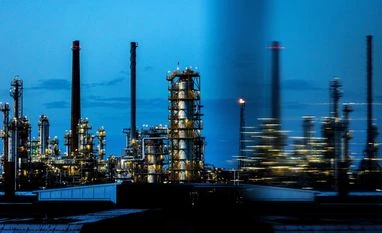
The state-owned Oil Marketing Companies (OMCs) are not expected to cut pump prices in the last two months of 2023, despite posting huge profits in the second quarter (July-September) of the financial year that beat market estimates, officials said on Sunday.
Indian Oil Corporation Limited’s (IOCL) consolidated net profit soared to Rs 13,713 crore in Q2 FY24, bouncing back from a loss of Rs 910 crore in the same quarter of the previous year. For Bharat Petroleum Corporation Limited (BPCL), consolidated net profit reached Rs 8,244 crore in Q2, up from a loss of Rs 338 crore in the previous fiscal year.
Hindustan Petroleum Corporation Limited’s (HPCL) result is awaited. However, all three have informed the government they are still facing recovery in diesel, an official said.
"Even in the second quarter of FY24, the OMCs had an under-recovery in marketing margins. That is expected to significantly widen given how the price of crude oil has jumped globally following the tensions in Israel," a senior Petroleum and Natural Gas Ministry official said.
The marketing margin is the net profit earned by OMCs by selling fuel at petrol pumps.
In August, Petroleum and Natural Gas Minister
Hardeep Singh Puri hinted that OMCs should cut prices by pointing out two successive quarters of growth. However, officials said the situation has changed now.
Retail fuel prices in India have been unchanged for a record 18 months now. Taking the national capital as an example, petrol and diesel prices last saw a revision on 6 April last year when prices of both were raised by 80 paise a litre. Since then, the OMCs have not raised prices throughout the war in Ukraine and the volatility in crude prices that have followed.
"The losses they had undertaken back then are yet to be made up for. We are in touch with them. A change in prices is unlikely at the moment," said another official.
He also pointed out that average levels of discounts on Russian crude have also reduced to less than $4/bbl in recent months, even as shipping costs have risen.
Since the Hamas’ attack on Israel on 7 October, Brent crude futures have repeatedly shot past the $90 per barrel levels, but have since come down. The prices could go up if the ongoing conflict escalates with the involvement of Iran.
Last week, the World Bank in its latest Commodity Markets Outlook report warned that prices can potentially rise to $140-$157 in the event of a 'large scale disruption' such as the 1973 Arab oil embargo.
The public sector OMCs control roughly 90 per cent of the retail market.
"The three companies will have limited flexibility to pass on higher raw material costs by increasing the retail selling prices of petrol and diesel in the current fiscal year because of the upcoming elections in May 2024," Moody's had said in a report in October.
Higher refining margins
Analysts had projected weak results for OMCs in Q2 due to a substantial fall in the marketing gains of blended margins, which fell to Rs 4.7/litre of fuel sold in the week ending September 24, according to a note by Nomura.
Similarly, Prabhudas Liladhar had pegged blended marketing margins for IOCL in Q2 at Rs 4.4/ltr, down from Rs 8.7/litre. Before this, marketing margins had been steadily climbing. It had risen from a low of Rs 3 per litre in Q4 FY23 to Rs 8-9 per litre of fuel sold in Q1 FY24.
However, stronger-than-expected average Gross Refining Margin (GRM) - the revenue refiners accrue from transforming each barrel of crude oil into refined fuel products, helped the OMCs.
IOCL reported that average GRMs stood at Rs 13.12/bbl for the first 6 months of FY24. This was nearly half the record $25.49/bbl recovered in the same period of the previous financial year.