Better growth prospects for small-caps has made Jefferies bullish on this market segment in the Asian region. In the Indian context, it has highlighted 15 stocks as potential multibaggers.
The list includes Cigniti Technologies, Man Infraconstruction, Computer Age Management Services (CAMS), Angel Broking, Cantabil Retail, JB Chemicals & Pharma, Action Construction, Central Depository Services (CDSL), Triveni Turbine, BLS International, Narayana Hrudayalaya, Ion Exchange India, Great Eastern Shipping, ICICI Securities and Zensar.
“A comparison of the growth forecasts for 2024F and the 12-month forward earnings per share (EPS) trends clearly highlights the earnings support for small-caps. While both the small-caps and large-caps have suffered downgrades for a while, the forward EPS trend shows significant improvement for small-caps since the fourth quarter of 2023 (Q4-23). Also, 2024F earnings growth is much higher for small-caps compared to large-caps in China, Hong Kong, India and Australia,” wrote Mahesh Kedia, Desh Peramunetilleke and Nicholas Ng of Jefferies in a recent note.
Small-caps in Asia, Jefferies said, have done well since 2001, with an excess return of 216 per cent versus the large-caps. COVID recovery turned out to be a significant catalyst for small caps, leading to a 27 per cent outperformance versus the large caps since 2021.
"An unwinding of the extreme concentration is likely to benefit small caps globally. Asia’s growth cycle is still looking healthy, which is an important consideration for small-cap performance. The other reason for small caps to do well in Asia has been the drag from the China large-caps, especially the private sector," the note said.
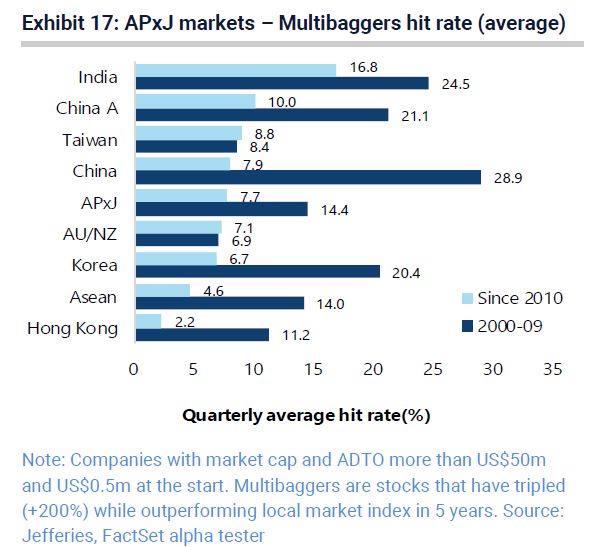
“The biggest change in hit rate has happened for the energy sector in the APxJ markets, which was the prime source of multi-baggers pre-GFC but has struggled since then,” the note said.
Another characteristic, according to Jefferies, which supports the case for multi-baggers in APxJ markets is the low sell-side coverage of the universe.
For the broader APxJ universe, it said, currently 49 per cent of the stocks are not covered by even one sell-side analyst, versus only 6 per cent for US and 19 per cent for Europe. In Asia, 30 per cent of multi-baggers had no sell-side coverage to start with.
So, how does one spot multi-bagger stocks, especially in the small-cap universe?
The key finding from Jefferies’ analysis is that small-cap companies with good earnings growth and robust quality characteristics are more likely to turn into multi-baggers over time. Significant R&D spend, higher SG&A spending and overseas expansion, too, Jefferies said, are key signals that help build moats for a company.
“We also find that companies that are value-based on FCF yield, EV/EBITDA and PEG have a higher multi-baggers hit rate. Lastly, presence of good momentum in cyclical old economy stocks and avoiding high beta boosts the probability of finding multi-baggers,” the note said.

 "Better growth supports the case for small-caps in Asia: Jefferies")












.JPG)