Home / Markets / News / Equity markets brace for impact as conflict in West Asia escalates
Equity markets brace for impact as conflict in West Asia escalates
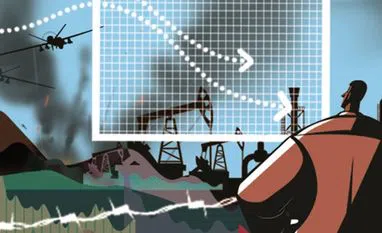
Escalating US-Iran tensions and fears of Strait of Hormuz disruptions are set to trigger a risk-off trade, with equities under pressure and oil, gold and safe-haven assets likely to gain
Domestic equity markets are poised for a weak start on Monday, tracking a sharp escalation in geopolitical tensions after the US and Israel launched strikes on Iran over the weekend.
The strikes reportedly killed Iran’s Supreme Leader Ayatollah Ali Khamenei, prompting retaliatory missile launches towards Israel and raising concerns over potential disruptions in the Strait of Hormuz — a critical artery for global oil supplies.
Analysts expect a “risk-off” reaction when markets reopen, with equities likely to come under pressure and safe-haven assets such as gold and US Treasuries gaining. Energy-intensive and cyclical sectors — including aviation, paint, and logistics — along with oil-marketing companies, could face the sharpest selling.
“In February, equity markets were already fragile. Against this backdrop, a US and Israeli attack on Iran would likely trigger broad-based selling across developed and emerging markets. We expect the ongoing rally in US Treasuries, oil, gold, and silver to extend,” said Nachiketa Sawrikar, fund manager at Artha Bharat Global Multiplier Fund. “For India, the impact is typically magnified: higher crude prices widen the current account deficit, stoke domestic inflation, pressure the rupee, and could lead to foreign outflows as global investors cut risk exposure,” he added.
Some oil majors and commodity trading houses are said to have suspended shipments through the Strait of Hormuz amid heightened security risks.
“The strike raises geopolitical risk premia as markets head into Monday’s open. The immediate reaction function is fairly predictable: safe-haven assets such as gold are likely to see an upside gap, while oil prices may firm on supply disruption concerns. Risk assets and high-beta currencies could face an initial bout of volatility,” Christopher Wong, FX strategist at OCBC, was quoted as saying by Reuters.
Energy analysts warned that oil markets could face their “worst fears” at the start of the week. Analysts believe crude oil could climb towards $100 per barrel if supply disruptions intensify. Many brokerages are projecting a $5–15 jump above the current $73 baseline.
In a report, Equirus Securities said, “If Iran’s 3.3 million barrels per day (3 per cent of global supply) is disrupted, and assuming a 3–5 per cent price response per 1 per cent supply shock, that implies a 9–15 per cent move. On a $70 per barrel (bbl) base, this translates into roughly $6–11/bbl upside, lifting crude towards $76–81/bbl purely on direct supply loss. However, markets do not price wars linearly. If escalation threatens the Strait of Hormuz, the premium becomes structural rather than proportional. Even partial disruption risk could embed a $20–40/bbl geopolitical premium, reopening a pathway towards $95–110+, well beyond the mechanical impact of Iran’s barrels alone.”
For India — a major crude importer — any sustained spike in oil prices risks widening the current account deficit, stoking inflationary pressures, and complicating the Reserve Bank of India’s policy calculus.
The geopolitical flare-up comes at a time when domestic markets are already on shaky ground. On Friday, the Sensex fell 961 points, or 1.2 per cent, to close at 81,287, while the Nifty 50 declined 318 points, or 1.25 per cent, to 25,179. The benchmarks have now logged losses for three consecutive months.
Foreign portfolio investors, who had briefly turned net buyers earlier in the month, resumed selling towards the end of February, offloading shares worth more than ₹10,000 crore in the last two trading sessions.
Volatility indicators have also edged higher. The India Vix rose nearly 3 per cent to 13.44 on Friday, signalling heightened uncertainty. Technical analysts view 25,000 on the Nifty as a key psychological support level, warning that any further spike in volatility could exacerbate downside risks. The Nifty last closed at 25,179, while the Sensex ended at 81,287 on Friday.
In wait-and-watch mode
Analysts expect a “riskoff” reaction when markets reopen, with equities likely to come under pressure
Safe-haven assets such as gold and US Treasuries may gain
Cyclical sectors — including aviation, paint, and logistics — along with OMCs, could face the sharpest selling
Energy analysts warned that oil markets could face their “worst fears” at the start of the week
Analysts believe crude oil could climb towards $100 per barrel if supply disruptions intensify

 "Equity markets brace for impact as conflict in West Asia escalates")

