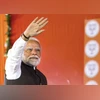
After the Lok Sabha stumble 18 months ago, the spectacular wins in Haryana, Maharashtra, Delhi and now Bihar will make Narendra Modi’s followers believe that his invincibility is back. And, India’s politics is back to being a one-horse race.
His opponents, at the same time, will think what they are doing wrong, why anti-incumbency doesn’t hurt Mr Modi or his partners, and how the INDIA bloc lost the momentum of the summer of 2024. They could begin by asking themselves some hard questions. More specifically, they should ask the Congress party, to which the devastating post-Lok Sabha slide of the Opposition is mostly owed.
There can be no challenge to the Bharatiya Janata Party (BJP) without a Congress revival. In West Bengal and Tamil Nadu, Mamata Banerjee and M K Stalin can still keep him at bay. Kerala has its own peculiar politics, but the BJP is growing, almost entirely at the cost of the Congress. In states where the Congress piggybacks on a votebank-rich regional party, it’s a liability. Check out Uttar Pradesh with Akhilesh Yadav’s Samajwadi Party in 2017, and Bihar with the Rashtriya Janata Dal (RJD) in 2020 and now.
Everywhere else, a direct BJP-Congress fight has been a non-contest after a heady flicker in 2024. And yet, the Congress retains just over 20 per cent votes nationally. Whether 44 seats in 2014 or 99 (with alliances) in 2024, that vote share has remained intact. One in five Indians simply votes for the Congress symbol. Let’s see it this way: In 2024, the Congress polled exactly 21.4 per cent of the vote; that was more than the aggregate vote share of the next eight parties from the National Democratic Alliance (NDA) and INDIA alliances.
It’s a lot of votes to begin with. How does the party see this? There are two upshots — one leading to the other.
The first, that the Congress does not need 37 per cent (the BJP’s approximate Lok Sabha vote) to beat Mr Modi. Even a five per cent shift can change India’s politics. The BJP, with a 31-32 per cent vote may still stay in power, but it will be in a genuine coalition. It can also open up the leadership race within the BJP. Does the Congress have the skills, guts and, most importantly, the humility to think about finding just that additional five per cent — from 22 per cent to 27 per cent?
Humility brings us to the next question. How does the Congress see its one-in-five vote share? A perpetual inheritance; so it continues to see itself as India’s Grand Old Party (GOP), or more specifically, India’s party of power by default.
That means it believes that, inevitably, and soon enough, voters will realise how stupid they were to vote for Mr Modi. What else will they do then except returning “home” to the Congress? This is disrespectful of competitive politics. If 11 Modi years have not “awakened” people from this “nightmare”, when will that “soon enough” be? It’s cruel to borrow the line Sonia Gandhi once used to mock Lal Krishna Advani in Parliament. But her description “Mungeri Lal ke haseen sapne” (beautiful fantasies) would fit her Congress aptly now.
Instead of seeing itself as India’s GOP, can the Congress reboot as a Modi-era startup with a committed 20 per cent vote as its initial capital? Since any startup must have a unique selling proposition (USP), this can be the Congress party’s. But after generations of being the default party of power, beginning afresh as a startup needs humility. Rahul Gandhi and his increasingly apolitical praetorian guard haven’t displayed that lately. If anything, even mild criticism draws the vilest social media abuse. That’s the only area where the Congress beats the BJP now.
The Congress’ repeated failures to build on its inherited capital bring us to its unquestioned leader, Rahul Gandhi.
Since 2013, he has built his pitch around what’s wrong with Mr Modi, the Rashtriya Swayamsevak Sangh and the BJP. It was communalism first, the death of Judge Brijgopal Harkishanss Loya next, then Rafale purchase, Adani and Hindenburg, Ambani-Adani and “Modi ji ke mitra” (the Modi cronies), vote-chori through the election commission, and social inequalities, which he was to address through a caste census. If all of these bombed so devastatingly, it should tell him something.
If the Congress had that humility, it would read its history. In 1971, Indira Gandhi promised India a better future and the combined Opposition gave a call to remove her. She swept that election with her counter: “They say Indira hatao (remove Indira), and Indiraji says Garibi hatao (eradicate poverty). You decide.” Given India’s demographics, voters will always be predominantly young, looking at the future more than leaning into the past.
Positive agenda is way more likely to work with them than bitterness, contempt or fear of the incumbent. For voters to reach that “anybody but my current leadership” fury, disappointments have to be much deeper. We saw these play out in 1977 (Mrs Gandhi, post-Emergency) and in 1989 (Rajiv Gandhi). The rout of the United Progressive Alliance (UPA) in 2014 was only marginally because of negativity. It was the success of Mr Modi’s positive promise of “achhe din” (better days).
What is Rahul Gandhi’s equivalent of “achhe din”? What’s he promised since the loss in 2014? Some giveaways like NYAY, free bus rides, and power and cash doles. On each, Mr Modi ups the offer. He owns the treasury.
Rahul Gandhi’s permanent angry young man act isn’t working. It worked for Amitabh Bachchan in the mid-1970s, when India battled about 30 per cent inflation, deep poverty and hopelessness. In any case, real politics isn’t a Manmohan Desai movie. In today’s equation, Mr Modi is promising Viksit Bharat. Rahul Gandhi hasn’t moved on from vote-chori and caste census. As Bihar shows, people have rejected the first. And Mr Modi has made the second his own.
Anger in any aspect of life can be a useful ploy if used wisely, deliberately and with great discretion. You also must know where to stop and return to that wagon of positivity. Let’s borrow from Rahul Gandhi’s father and call it the “Mera Bharat Mahan (Make India Great Again?)” train.
Mr Modi will play you, and that’s fair in politics. Deep, chronic anger, however, will walk you into unforced errors. In just the week leading up to the first round of Bihar voting, Rahul Gandhi made two pitches that he better reflect on. First, that the same 10 per cent (caste) elites that control other institutions and power centres also control the army. Second, that Jay Shah controls all of Indian cricket. This is at a time when the armed forces have peak adulation after Operation Sindoor and Indian men and women have won three International Cricket Council trophies and an Asia Cup (where they beat Pakistan three times) in succession. In any case, the army and cricket are the holiest of India’s holy cows. You either have to be nuts to take them on or very, very angry. It won’t get you any votes.
It is evident that there can be no challenge to Mr Modi without a rejuvenated Congress party. To be worthy of leading this challenge, the Congress has to shed anger, disdain, even contempt for Mr Modi, and try some humility. “Why does Mr Modi keep winning and we losing” is a good question to begin with. The best beginning to fighting an all-conquering rival is to show him some respect, not arrogance. Without that reboot, the party will melt away like so many arrogant “soon-to-be unicorn” startups. Or, the way it’s going, even the regional partners will begin to see the Congress as an unaffordable liability and move away, finding modus vivendi with Mr Modi rather than fighting him — Just like N Chandrababu Naidu. And who knows, it may be ripe for the political equivalent of a shareholder revolt and management change.
By special arrangement with The Print