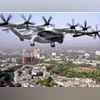
Imagine a future where busy commuters soar above congested roads in sleek, electric-powered air taxis, reaching their destinations in minutes rather than hours. From Gurugram to Connaught Place, and from Mumbai Airport to Nariman Point, a new dimension of urban transport is set to unfold as electric-Vertical-Take-off-and-Landing (eVTOLs) aircraft, also known as air taxis, prepare to transform city travel.
According to the Directorate General of Civil Aviation (DGCA), VTOLs are defined as aircraft powered by unconventional energy sources, with a maximum takeoff weight of less than 5,700 kg, operated by a pilot, and restricted to daytime operations under visual flight rules.
Such eVTOLs look like large drones and evoke images of floating bubbles. Unlike conventional aircraft that require runways, they can take off and land vertically, making them well-suited for dense urban environments where space is limited. These aircraft use electric propulsion, making them quieter and more environment-friendly than traditional helicopters. Advanced air traffic management systems aim to ensure safe and efficient operations. In time, pilotless capabilities are expected to take over.
Internationally, the air-taxi business is evolving rapidly. Dubai is set to begin full-scale commercial operations with four vertiports by 2026. Other cities actively gearing up for commercial operations include Los Angeles, New York, Chicago, Paris and Singapore. Some could start as early as the last quarter of 2025.
India’s regulatory landscape is also preparing to accommodate eVTOLs. The DGCA has formed six dedicated working groups to develop rules and establish an operational framework. Each group focuses on a specific area: Vertiports (take-off and landing points), aircraft type certification, crew licensing, operating permits, air traffic management, and MRO (maintenance, repair, overhaul) and safety. Reports from these working groups have been submitted, and in September 2024, the DGCA issued comprehensive guidelines on its website, which are publicly accessible. However, no operational licenses have been issued to date.
Along with the DGCA, the Indian private sector is already actively engaged with this technology. The IIT Madras-incubated ePlane Company has made history by becoming the first private Indian firm to secure Type Certification approval from the DGCA for its eVTOL aircraft, the e200X.
Similarly, InterGlobe Enterprises, the parent company of IndiGo, and US-based Archer Aviation are getting set to launch their eVTOL services by 2026. Other Indian startups, including Ubifly Technologies and Nalwa Aero, are also developing eVTOL solutions, while global players like SkyDrive and JetSetGo are working on commercial eVTOL routes in India. Ubifly Technologies is the first private Indian company to receive Design Organisation Approval from the DGCA for an electric aircraft.
In step with these developments, major Indian airports are preparing to develop vertiports as specialised hubs for VTOL aircraft, complete with dedicated airspace corridors, advanced air traffic management systems, and charging stations. A new cadre of dedicated air traffic controllers may also be needed to coordinate low-altitude craft, such as drones and air taxis.
A key problem area is that the development of supporting infrastructure remains underdeveloped, which is a source of concern. The sector’s growth depends on the strategic selection of vertiport locations. These takeoff and landing sites must be situated in high-demand areas, primarily urban centres and their surrounding regions. However, limited urban space, high real estate costs, and air traffic restrictions around sensitive areas pose challenges for building multiple landing zones and parking facilities.
Another challenge is power supply. Unlike electric vehicles, eVTOLs rely on larger and heavier batteries. To keep operations viable, these aircraft require rapid turnaround times, necessitating ultra-fast charging within a 10–12-minute window. Additionally, various eVTOL manufacturers use different battery configurations, each designed to optimise flight range and efficiency. These varying charging needs must be accommodated.
Thus, establishing this new category of base-infrastructure to support eVTOLs requires a multidisciplinary approach, combining urban planning, energy management, vertiport construction, and regulatory expertise.
But rolling out the technology is only half the battle; the other half lies in gaining public acceptability. With fares expected to be significantly higher than conventional transport options, will even time-stressed commuters find eVTOLs worth the premium? Preliminary studies suggest that a seven-minute flight from Connaught Place to Gurugram could cost around ₹4,500 for a single passenger, whereas an Uber ride today takes about two hours and costs around ₹1,700.
Then there’s the charge of “elitism”. Critics may accuse the establishment of pandering to the elite in a situation where mass urban transportation is struggling. The debate here would echo some of the negative sentiments expressed during the introduction of the Bullet Train project. The saving grace is that the air taxi initiative is expected to be a 100 per cent private enterprise with no public expenditure. The UDAAN scheme has already shifted the perspective, viewing air travel not as a luxury but as a necessity for providing connectivity. Additionally, medical emergency transportation will be a big boon.
Finally, the eVTOL evolution needs to be seen as another futuristic part of an integrated transport ecosystem. If it can, even partly, ameliorate the pain of urban commuting, eVTOLs will have done their job.
Get set for the first Air Taxi ride in 2026!
The author is an infrastructure expert. He is also the founder & managing trustee of The Infravision Foundation. Research inputs from Vrinda Singh