A sure sign that something is amiss in a political party is when its members start saying its name should be changed.
The move to change a name usually heralds a split.
In the Janata Dal (United), or JD(U), this discussion started last month, when its National Working President Sanjay Jha said at Khagaria, Bihar: “The time has come to change the name of the JD(U) to Janata Dal (Nitish).” The refrain was taken up immediately by Shrawan Kumar, a Kurmi leader considered a claimant to the caste capital Nitish Kumar represents, and Bijendra Kumar Yadav, current deputy chief minister of Bihar and a man who has represented the same constituency (Supaul) for nine terms without a break.
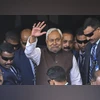
As Nitish Kumar battles health problems and a legacy that combines a formidable caste coalition, good governance and the politics of opportunism, many in the party are eyeing the corner office in the belief that they would be better placed to control the trajectory of Bihar politics if they can get their hands on this weapon. They haven’t reckoned with the sense of political discernment of the average Bihari.
Bihar’s caste survey tells us that the Other Backward Classes (OBCs) and Extremely Backward Classes (EBCs) make up nearly 63 per cent of the state’s 140 million people. Those in the general category (forward castes like Brahmins and Bhumihars) are just around 15 per cent. Naturally, with this kind of social composition, Bihar’s caste politics is quite different from that of Uttar Pradesh (UP), where upper castes range between 18 and 22 per cent of the population. In UP, upper castes are numerous enough to matter in a political equation. In Bihar, backward-caste combinations count more.
Nitish Kumar grasped this early on, mastering and playing with the complexity of social coalitions. His greatest contribution to Bihar politics was forcing all political players to accept the reality and enduring presence of caste, creating a playing field where ignoring caste was at their own peril. Lalu Prasad had already tapped into the OBC vein and extended the coalition to include Muslims. Nitish Kumar offered shelter to those below the OBCs and, frequently, their victims: The EBCs, including lower castes among the Muslims. The BJP tried hard to offer lofty ideals to replace caste identity. But it met with limited electoral success. With Nitish Kumar/JD(U)’s base, it could manage the numbers to form a government.
But if Nitish Kumar and Lalu Prasad were to join up, the BJP, despite its appeal to nationalism and Hindutva, would find itself in the opposition space. Its discomfort with caste identity — as Arun Jaitley had told Business Standard once — made it a camp for forward castes. And when Nitish Kumar’s EBC base joined it, it became an unbeatable combination.
Over the years, while castes have migrated to the Bharatiya Janata Party, the biggest chunk of EBCs has remained loyal to Nitish Kumar and the JD(U). For the BJP, this is a problem. When the EBCs and the OBCs — Nitish Kumar and Lalu Prasad — come together, the BJP finds itself elbowed out as it found in 2013 and 2022, when Nitish Kumar walked out of the National Democratic Alliance (NDA) and joined up with Lalu Prasad.
In the 2015 Assembly polls, the Lalu-Nitish combine won a handsome victory (178 of the 243 Assembly seats). But Nitish Kumar returned to the NDA in 2017. The result of his walkout again in 2022 and his subsequent return to the NDA may have confused the chatterati outside Bihar. In Bihar, it burnished, especially among his caste base, his credentials as kingmaker. In the 2025 Assembly elections, the BJP got 89 seats, still short of forming a government on its own. But with Nitish Kumar (85 seats) and other groups, the coalition reached 202.
All this points to one inescapable conclusion: The JD(U) with Nitish Kumar still has a base among EBCs. If this base decamps to Lalu Prasad, the BJP could be in trouble, and for that reason, the JD(U) needs to continue to exist and stay in the NDA tent. In Bihar, the project to supplant caste with Hindu nationalism is still incomplete.











 Connect with us on WhatsApp