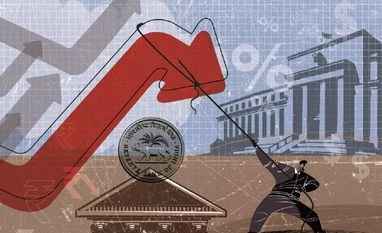
There was a sense that the US Fed (the Fed) was at the end of its journey, of getting the US consumer price index (CPI) on its path to the 2 per cent target. This job has been complicated in recent weeks by a strong showing in the US economy, and by concerns about sustained exports from Ukraine. It appears that the US is now headed for rate hikes of 50 basis points more. Here in India, monetary policy action by the Fed and the Reserve Bank of India (RBI) has significantly reined in the post-Covid expansion. The RBI’s strategy of holding is on track.
In 2021, the Fed started chasing a significant inflation problem in its jurisdiction. It hiked the rate 10 times from March last year and its short rate now stands between 5 and 5.25 per cent. Alongside this, Russia invaded Ukraine in February last year. These two events created new pressures in the world economy. The idea of inter-disciplinary thinking, to better comprehend an interconnected world, sometimes veers on cliche. But the events after 2022 were a fresh reminder that with 50 years of deepening globalisation behind us, we are now in a richly interconnected world. There is now a large array of consequences, all over the world, of these two forcing functions.
Tightening by the Fed impacted illiquid and risky assets worldwide, and that in India translated into a changed world for start-ups and crypto currencies. The invasion of Ukraine triggered fundamental rearrangements in the global energy market. Europe, which was the most important customer of Russian oil and gas, turned away from this, and pushed through a remarkable expansion of renewable energy. With the European net-zero targeted in 2035, Russian gas will never find its way into the European market, except for the unlikely scenario of a rapid regime change in Moscow and a new democratic government. Russia needs to sell as much oil as possible in order to fund the war, and the West forced a $60/barrel price limit on these sales. More generally, fossil-fuel producers have started feeling the heat of global decarbonisation, and there are incentives to produce more while you can. These issues have added up to a soft global energy price environment.
Monetary policy works by slowing economic activity and obtaining reduced demand. For some time, there was a sense that the Fed was at the end of its journey of tightening. But on June 2, there was a surprising release of strong employment data for the US, with jobs growth of 339,000 (seasonally adjusted) in May. Prime-age labour-force participation (i.e. for persons of age 24-54) rose to 83.4 per cent, which is quite tight. This suggests that the Fed needs to do more to crimp demand.
The war continues to create unpleasant surprises. An important dam on the Dnipro river in Ukraine, the Kakhovka dam, was under Russian control. It created a reservoir with 18 cubic kilometres of water (about twice that of the Gobind Sagar Lake, behind the Bhakra Nangal dam). The dam was blown up from the inside on June 6. This flooded a large area, and about 600,000 hectares lost irrigation. Ukraine is an agricultural powerhouse. Its exports were already down by 40 per cent owing to the war. The destruction of the dam further crimps its ability to export. This has affected global food prices.
The destruction of the dam also impacts manufacturing in that region, including an ArcelorMittal plant. This raises the scenario of a fresh spurt of supply difficulties in 2023, on a smaller scale, against the supply chain crisis of the post-Covid recovery. Even if Ukraine fares very well in its first major counteroffensive, the lands that are retaken will not be restored to normal economic activity for many years, owing to the scale of the destruction, and fear of Putin’s Russia.
These difficulties have adversely impacted the Fed’s search for price stability. CPI inflation in the US has improved, but it remains at about 5 per cent, which is quite a distance from the inflation target of 2 per cent. The recent data flow (including US inflation and production in Ukraine) has shifted views on what the Fed will now need to do. The consensus now envisions them going up to between 5.5 per cent and 6 per cent. No cuts are expected until 2024.
In India, the macroeconomic context is quite different. Monetary policy tightening by the RBI and the Fed has helped pull back the post-pandemic expansion. Many important indicators show slow growth in the latest year. Headline inflation has dropped greatly over the year, and stood at 4.7 per cent in the latest data (of April), which is only 70 basis points above the target of 4 per cent. The RBI’s main strategy, of pausing after February 2023, is on track.
The inflation-targeting system has worked well in reshaping the incentives of the RBI. It requires the RBI to forecast inflation 12 to 18 months out, show its homework in public, and respond to those forecasts today while engaging with three independents on the monetary policy committee. Surges of inflation have generated more rapid action by the RBI than was the case prior to the onset of inflation targeting in 2015. Inflation targeting is symmetric in that it paves the way for rapid action by the RBI as and when the inflation forecast drops below 4 per cent. If the problem of Ukrainian food exports does not cause too much global food inflation, we may be in that scenario in coming months.
If the Fed hikes rates and the RBI does not, this will give some rupee depreciation. This will have a valuable impact upon the sluggish local economy. For domestic producers of tradeables, rupee depreciation lifts the top line when imported goods become a bit more expensive. For domestic exporters, products priced in rupees become a bit cheaper when the domestic currency depreciates. Both these channels of influence will help the local economy at a time when this is required.
The writer is a researcher at XKDR Forum