India was among the first responders after a 7.7 magnitude earthquake hit Myanmar on March 28. Indian rescue teams shared visuals of robots and drones helping in searches for survivors among the rubble of collapsed buildings.
Increasingly, robots and drones are being deployed across the world for search and rescue. The rapid improvement in technology and innovation is providing immense support for disaster management.
Researchers, scientists and technology innovators have created drones and robots of various shapes and sizes to aid rescue teams. Scientists at the University of California, Berkeley, have created what they say is the world's tiniest wireless flying robot, inspired by bumblebees. This miniature marvel weighs just 21 milligrams and is less than one centimetre in diameter. It can hover, change directions, and hit small targets with precision.
The university’s researchers explained that an external magnetic field makes the robot spin, generating enough lift for it to fly. The robot holds promise for applications in surveillance, environmental monitoring, and search-and-rescue missions.
Researchers at the Massachusetts Institute of Technology (MIT) have developed a small yet powerful robot that mimics an insect's ability to jump and traverse rough, slippery surfaces. The robot hops over tall obstacles and it can carry loads up to ten times its own weight, even though it is smaller than a thumb. Crawling robots struggle with tall obstacles or slippery inclines. Conversely, flying robots consume a lot of energy, restricting their range before needing a recharge. The MIT team discovered a balance: a hopping robot that travels through challenging terrain while conserving energy.
Researchers at the University of Notre Dame have developed SPROUT, a type of soft robot designed to go beneath collapsed buildings. SPROUT can extend and manoeuvre around obstacles and confined spaces. First responders can deploy SPROUT under collapsed structures to explore an area, map the environment, and identify optimal entry routes through the rubble.
SPROUT, short for Soft Pathfinding Robotic Observation Unit, comprises an inflatable tube made from airtight fabric that extends from a stationary base. The tube is inflated with air and a motor controls its extension. Like a worm or a snake, the tube can navigate around corners and small openings in the debris. A camera and multiple sensors on the tube can capture images and even generate maps of an area.
Search and rescue robots — made for land, marine and airborne situations — can be autonomous or remotely managed by operators. In earthquakes or fires, secondary tremors and explosions put rescuers at risk. Robots keep rescuers away from such danger while managing search operations. The global search and rescue robots market size reached $22.39 billion in 2024, according to a report by Expert Market Research. The market is projected to grow to $117.19 billion by 2034.
“The increasing technological advancements and research and development activities are anticipated to result in the development of robots equipped with rolling, flying, and walking capabilities that can explore and navigate locations previously deemed impossible to explore,” says the report.
A separate report by Research and Markets says, “Asia Pacific is projected to grow at the fastest pace as the major countries in the region are increasing their investments in robotics and trying to become the hub of robotics in the world.”
India's Parliament in March passed amendments to the National Disaster Management Act to empower local units and for use of technical tools for preparedness and operations. India will have to invest in new age technology to strengthen the country’s disaster management abilities. Public private collaboration in disaster technology management will help predict and mitigate the impact of calamities.

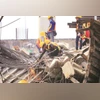 "Operation rescue teams increasingly relying on robots in disaster zones")












 Connect with us on WhatsApp