Home / Opinion / Columns / Should the BJP worry about Rahul Gandhi meeting US officials?
Should the BJP worry about Rahul Gandhi meeting US officials?
Gandhi's reception in the US might, at best, put some pressure on the Modi regime by implying that despite his shabby disqualification from parliament, US believes he has a future in Indian politics
6 min read Last Updated : Jun 12 2023 | 8:36 AM IST
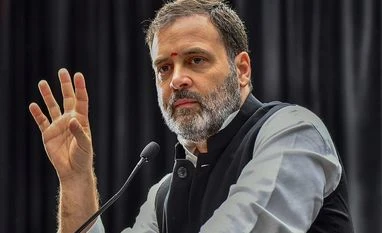
Indian political observers are in a tizzy over Congress leader Rahul Gandhi's reported meeting with the US assistant secretary of state for South Asia, Donald Lou, and his unconfirmed visit to the White House. Lou, after all, was accused by former Pakistan Prime Minister Imran Khan of playing a central role in an alleged US-backed conspiracy to oust his government in April 2022.
What would normally be courtesy calls are being imbued with sinister motives as they come ahead of Prime Minister Narendra Modi's state visit to the US from July 21 to 24. The ruling party's spokespersons and propagandists are labelling these interactions as initiatives by external forces to facilitate democratic change in India. Earlier this year, on his return from the UK, the Bharatiya Janata Party (BJP) lambasted Rahul Gandhi for seeking the "intervention of the US and Europe" in India's internal affairs. This time the attack was initiated by external affairs minister S Jaishankar's remarks, "I don't think that taking the politics of the country abroad is in the interest of the country. And I also don't think that he will gain credibility because of it." Union home minister Amit Shah has chided Gandhi, saying he should be "ashamed" of discussing Indian politics on foreign soil and warned him, "Rahul Baba, the people are watching you."
Both in the UK and the US, Gandhi, however, has said that the erosion of democratic institutions under the Modi regime was India's domestic problem and would ultimately be resolved internally; and that India's democracy was a "global public good" whose erosion would have a fallout beyond India's borders. Nothing in Gandhi's criticism of the BJP government is new: its silence on the targeting of religious minorities, muzzling the press, prosecuting journalists and using state agencies to target political opponents are regularly highlighted by the international media and human rights organisations.
Those imbuing ominous intent to Rahul Gandhi's meeting with the much-maligned "regime changer" Donald Lou would do well to recognise that US relations with India are not structured in a manner that a regime change in Delhi will impact. This does not mean that the Democratic establishment of President Joe Biden is entirely happy with the Modi government. Only a month before his state visit, US secretary of state Anthony Blinken launched the 2022 International Religious Freedom Report compiled by the State Department. Introducing the report, a State Department official said, "What we outline in today's report is a targeted – continued targeted attacks -- against religious communities, including Christians, Muslims, Sikhs, Hindu Dalits, and indigenous communities; dehumanising rhetoric, including open calls for genocide against Muslims; lynching and other hate-fuelled violence, attacks on houses of worship and home demolitions, and in some cases impunity and even clemency for those who've engaged in attacks on religious minorities – we're also continuing to see, at the state level, some restrictions on religious attire." He also drew attention to the US Holocaust Museum's early warning project ranking India eighth among 162 countries for the highest risk of mass killings.
However, the Biden administration's dissatisfaction with India on the erosion of democratic freedoms, including religious freedom, hardly amounts to US support for the regime's ouster. It would be more than willing to overlook these negative developments if India's position on Russia and China became more helpful. This is especially so when the Ukraine war has reached a critical stage, with its outcome potentially deciding the emerging power balance globally.
After Manmohan Singh, PM Modi is perhaps the most pro-US head of government that India has seen. It would be in the US interest to encourage him to fall in line with its strategic interests than to raise his suspicions about US intentions on the eve of his state visit. The visit of US secretary of defence Lloyd Austin was a significant precursor to the visit. Austin announced a new paradigm of bilateral defence cooperation, including giving India access to cutting-edge technologies for defence modernisation. Reportedly, high-end technology transfer will include General Electric sharing fighter jet engine technology and the supply of 30 MQ-9B armed drones worth over USD 3 billion from General Atomics Aeronautical Systems Ltd. Some of these deals may be announced during the state visit.
However, India will not be allowed to forget the reasons for deepening defence cooperation. Austin underscored this in his press briefing in Delhi, saying that such cooperation matters "because we all face a rapidly changing world. We see bullying and coercion from the People's Republic of China and Russian aggression against Ukraine that seeks to redraw borders and threatens national sovereignty."
Until now, India has sought concessions from the US without delivering anything tangible in return. Promising lucrative defence contracts to US firms and some movement forward on climate change, the prospect of joining the trade pillar of the Indo-Pacific Economic Framework or liberalising digital data flows would signal a movement forwards but may not be enough. India will be encouraged to identify itself with the geostrategic issues of importance to the US.
The US has tolerated the increasing dysfunctionality of India's democratic system in the hope of developing a deeper partnership to counter a common strategic rival, China. India was also allowed to sidestep US sanctions on Russia and pussyfoot on the Russian invasion of Ukraine. PM Modi's state visit is likely to be an opportune moment for the US to force greater clarity on India's position on taking on both China and Russia.
Rahul Gandhi's reception in the US might, at best, put some pressure on the Modi regime by implying that despite his shabby disqualification from parliament, the US believes he has a future in Indian politics and it will be happy to do business with other potential leaders who might emerge after the 2024 general election. This could be useful in nudging PM Modi towards greater cooperation as a key alliance partner.
Disclaimer: These are the personal opinions of the writer. They do not reflect the views of www.business-standard.com or the Business Standard newspaper
Disclaimer: These are personal views of the writer. They do not necessarily reflect the opinion of www.business-standard.com or the Business Standard newspaper