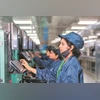
India’s boom in electronics manufacturing is reshaping the country’s labour market. As the recent data from TeamLease Services showed, women have now overtaken men in employability in the sector, 54 per cent as against 51.5 per cent, driven by stronger apprenticeship participation and job readiness. This shift comes at a time when the sector is rapidly expanding, with output exceeding $125 billion and a target of $500 billion by 2030. In several electronics clusters, women constitute over half the workforce, and in some facilities, their share is as high as 70-80 per cent. The majority of the women are equipped with the skills needed for shop-floor employment, underscoring their increasing readiness for entry-level roles in manufacturing. Industrial hubs such as Sri City — where women form nearly half the workforce, supported by transport, child care, and training ecosystems — demonstrate that inclusion is not only possible but productive.
 
This aligns with a broader economic understanding: Women’s participation will increase as employment opportunities grow. Bangladesh’s textile and apparel sector, for example, has historically been powered by women, who made up over 80 per cent of the workers until the 1990s and still account for over 53 per cent today, driving a sector that contributes around 83 per cent of the country’s export earnings. However, India’s trajectory remains constrained by structural weaknesses. India has not witnessed job creation in labour-intensive businesses to its potential. A significant share of female employment continues to be concentrated in agriculture and family-run enterprises, which are often informal and low-paying. While female labour-force participation has inched up to around 40 per cent, it remains well below levels seen in developed economies such as the United States (around 56 per cent), the United Kingdom (about 57 per cent), and Sweden (over 60 per cent). Female labour-force participation in urban India remains limited to about 27 per cent, underscoring limited access to employment opportunities.
 
Three interlinked challenges persist. First comes regional disparity. While southern clusters are more inclusive, northern states lag significantly, reflecting sociocultural barriers and weaker industrial ecosystems. The second is access constraints. Safety concerns, lack of transport, and inadequate accommodation continue to deter women. Third, and most crucial, is retention. Nearly half the women drop out mid-career due to their family responsibilities and the absence of institutional support systems. Equally concerning is the issue of job quality. Women are largely concentrated in low-value roles, with limited mobility into technical or supervisory positions. A high number of contract jobs and limited social security further weaken long-term participation. Importantly, the new labour Codes aim to improve safety, expand social security, and allow women to work across shifts and roles, potentially widening the talent pool. Scaling up the “campus model”, which integrates housing, health care, child care, and recreation, can significantly improve retention. Equally important are the skilling systems, which can enable upward mobility along the employment ladder. If India can bridge this gap, its manufacturing rise could become a story not just of scale but of structural transformation.

One subscription. Two world-class reads.

Already subscribed? Log in

Subscribe to read the full story →
*Subscribe to Business Standard digital and get complimentary access to The New York Times

Smart Quarterly

₹900

3 Months

₹300/Month

SAVE 25%

Smart Essential

₹2,700

1 Year

₹225/Month

SAVE 46%
*Complimentary New York Times access for the 2nd year will be given after 12 months

Super Saver

₹3,900

2 Years

₹162/Month

Subscribe

Renews automatically, cancel anytime

Here’s what’s included in our digital subscription plans

Exclusive premium stories online

  • Over 30 premium stories daily, handpicked by our editors

Complimentary Access to The New York Times

  • News, Games, Cooking, Audio, Wirecutter & The Athletic

Business Standard Epaper

  • Digital replica of our daily newspaper — with options to read, save, and share

Curated Newsletters

  • Insights on markets, finance, politics, tech, and more delivered to your inbox

Market Analysis & Investment Insights

  • In-depth market analysis & insights with access to The Smart Investor

Archives

  • Repository of articles and publications dating back to 1997

Ad-free Reading

  • Uninterrupted reading experience with no advertisements

Seamless Access Across All Devices

  • Access Business Standard across devices — mobile, tablet, or PC, via web or app

Topics :Electronic manufacturingIndustry Newswomenwomen employmentEditorial CommentBusiness Standard Editorial CommentBS Opinion

Next Story