The farcical drama of a stalled escalator and a failed teleprompter symbolised the dystopian state of global politics as United States (US) President Donald Trump delivered his speech at the 80th session of the United Nations (UN) General Assembly. The speech, which ran to 56 minutes against the 15 minutes allotted to each world leader, was vintage Trump; disjointed, rambling, mostly fact-free and infused with MAGA (Make America Great Again) tropes. The golden age of America had begun; migration is a threat and countries that accepted migrants were “going to hell”; climate change was the “greatest con job perpetrated on the world”; he was responsible for stopping seven wars; Shariah law would be imposed in London; Christianity was under threat; recognising Palestine was a boost to Hamas; European countries were major buyers of Russian oil, and so on. With variations, the speech hewed to the toxic version delivered at his second inaugural in January.
Where his speech was met with derisive laughter in his first term, this time his audience heard him in stony silence, an acknowledgement perhaps that the United States of America had abdicated its role as a force of positive change in the world. The collective response to the US President’s remarks was better illustrated by the strong applause that greeted remarks by the leader of a large Muslim state, Indonesia’s Prabowo Subianto, who followed immediately after. He observed: “Might cannot be right; right must be right. No one country can bully the whole of the human family.” But it was Brazilian President Luiz Inacio Lula da Silva who enunciated the threat posed by leaders of Donald Trump’s ilk. He spoke of how the ideals that inspired the UN’s founders in 1945 were being threatened by anti-democratic forces that “worship finance … praise ignorance, and act as physical and digital militias and restrict the press”.
The US President was, however, right about one thing — the failure of the UN to act as an effective force of peace and security. True, Mr Trump has accelerated the process by withdrawing from the UN’s Human Rights Council, clawing back $1 billion in funding for the UN and proposing to end UN contributions. The US accounts for 22 per cent of the UN’s regular budget and 26 per cent of the peacekeeping budget. He may have overlooked the fact the US has been responsible for this decline by refusing to follow its guardrails. The UN’s increasing peripheral role in global politics in the 21st century began in 2003, when US President George W Bush invaded Iraq in breach of the UN Charter. Today, the US backing of Israel’s military operations is unlikely to see the emergence of a Palestinian state despite belated European backing.
At the same time, the five permanent members of the Security Council, the UN’s key decision-making body, have been at loggerheads, stalling a consensus on key global issues — from climate change to revanchist invasions of sovereign nations and human rights. Mr Trump’s UN address unwittingly underlined the urgent need to realign the global institutional architecture to reflect contemporary realities. Declining powers such as the United Kingdom and Russia should be replaced by Germany, Europe’s undisputed economic powerhouse, or giants of the Global South such as Brazil and India. A more representative institution may not forestall the emergence of authoritarian nationalists. But it may allow greater attention to be paid to the urgent issues that destabilise the world today.

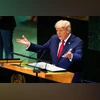 "Trump's UN speech exposes both America's decline and UN's paralysis")










 Connect with us on WhatsApp