Trust in elections

Faith in EVMs should be restored and maintained

Polling official,EVM
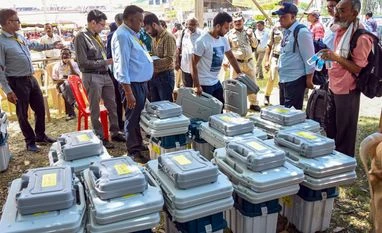
Polling officials collect EVM and other election material at a distribution centre on the eve of the first phase of voting for Lok Sabha elections, in Jabalpur, Thursday, April 18, 2024. (Photo: PTI)
Business Standard Editorial Comment Mumbai
3 min read Last Updated : Apr 18 2024 | 10:18 PM IST
India’s Lok Sabha elections, which kick off today, are a uniquely vast undertaking: They take weeks to conduct, in several phases across the country. The first phase will see voting in only 102 of the 543 Lok Sabha constituencies. As compared to the voting, the counting of votes is remarkably speedy. For the past two decades, votes have been counted swiftly and securely through the use of electronic voting machines (EVMs). Results are known within hours most of the time — a clear difference from other large democracies. Slow counts, as in the 2020 presidential election in the United States, encourage losers to challenge the authenticity of the results. EVMs have thus significantly improved the credibility of Indian electoral results. The Supreme Court is currently, however, hearing a plea from some well-regarded non-government organisations that seek to, if not restore paper ballots, ensure that each electronic vote has a paper counterpart that is counted separately. The court has reserved its judgment for now, after two days of hearing. Without prejudice to the court’s decision, it must be understood that the broader thrust of the plaintiffs’ argument might endanger Indian democratic processes. 
 
The judges have correctly noted that the ballot-paper era prior to EVMs was rife with electoral misconduct and malpractice. The Election Commission has argued that counting all the paper receipts of votes — voter verifiable paper audit trails, or VVPATs — would take days or weeks. Currently, about 5 per cent of VVPATs are counted as a random audit of the results of a particular constituency. The plaintiffs in this case have argued that some countries, like Germany, have returned to ballot paper after experiments in electronic voting. But the German constitutional court that delivered the decision did so on the principle that the process should allow for the possibility of public audits by non-experts — which the VVPAT does indeed do. The principle of transparency can be satisfied by more details of the process and more random audits; it does not seem to require the wholesale abandonment of electronic voting altogether. 
 
Politicians who lose elections, regardless of party, like to blame EVMs. But, viewed objectively, these doubts should be dismissed. All major parties both win and lose elections in the EVM era. Many state governments are controlled by parties that are in Opposition at the Centre; and it is state government employees that oversee elections all over the country. This is, in many ways, a disaggregated exercise. The plaintiffs in this case might have sensible arguments to make about the weaknesses introduced into the system by the way the new VVPAT machines are constructed and connected to the ballot machines. These can be addressed by the court and the Election Commission. But broader doubts about electronic voting cannot be allowed to persist in the absence of any data suggesting fraud or misalignment. The hundreds of millions of Indians who will be voting starting today have faith in the electoral process. For some of them it is their only voice in their future, and they value it correspondingly. Causing them to disbelieve in the system without the slightest hard evidence would be inappropriate at the very least. EVMs cannot be made an eternal scapegoat for political outcomes.

One subscription. Two world-class reads.

Already subscribed? Log in

Subscribe to read the full story →
*Subscribe to Business Standard digital and get complimentary access to The New York Times

Smart Quarterly

₹900

3 Months

₹300/Month

SAVE 25%

Smart Essential

₹2,700

1 Year

₹225/Month

SAVE 46%
*Complimentary New York Times access for the 2nd year will be given after 12 months

Super Saver

₹3,900

2 Years

₹162/Month

Subscribe

Renews automatically, cancel anytime

Here’s what’s included in our digital subscription plans

Exclusive premium stories online

  • Over 30 premium stories daily, handpicked by our editors

Complimentary Access to The New York Times

  • News, Games, Cooking, Audio, Wirecutter & The Athletic

Business Standard Epaper

  • Digital replica of our daily newspaper — with options to read, save, and share

Curated Newsletters

  • Insights on markets, finance, politics, tech, and more delivered to your inbox

Market Analysis & Investment Insights

  • In-depth market analysis & insights with access to The Smart Investor

Archives

  • Repository of articles and publications dating back to 1997

Ad-free Reading

  • Uninterrupted reading experience with no advertisements

Seamless Access Across All Devices

  • Access Business Standard across devices — mobile, tablet, or PC, via web or app

Topics :Business Standard Editorial CommentLok Sabha electionsEVM machineIndian democracy

Next Story




