US' approach to Pak terror raises questions on Quad's effectiveness

The fact that a Quad foreign ministers' meeting was held a day after Mr Trump was sworn in for a second term and talks began for a New Delhi summit later this year is seen as a sign of hope

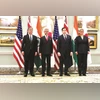
External Affairs Minister S Jaishankar (second from left) with Japanese counterpart Iwaya Takeshi (left), US Secretary of State Marco Rubio,  and Australia's Penny Wong during a Quad Foreign Ministers' meeting  in Washington DC on January 21. (Photo:
External Affairs Minister S Jaishankar (second from left) with Japanese counterpart Iwaya Takeshi (left), US Secretary of State Marco Rubio, and Australia’s Penny Wong during a Quad Foreign Ministers’ meeting in Washington DC on January 21.
Business Standard Editorial Comment Mumbai
3 min read Last Updated : Jul 02 2025 | 11:54 PM IST
The joint statement at the Quad foreign ministers’ meeting in Washington has reflected India’s concern about cross-border terrorism by condemning “in the strongest terms” the terror attack in Pahalgam, which killed 25 Indians. This is the first Quad foreign ministers’ meeting since Operation Sindoor. The emphatic language of the condemnation would be gratifying for India after Foreign Minister S Jaishankar’s impassioned appeal for the Quad to understand India’s right to defend itself against terrorism. Mr Jaishankar’s eloquence was aimed at the United States (US); given the nature of the current administration in Washington, achieving this shared objective could become challenging.
 
This much has been clear from US President Donald Trump’s lunch meeting on June 19 with Pakistan Army Chief Asim Munir, whose complicity in the Pahalgam terrorist attack just two months before is hard to ignore. No surprise, the objective of this misleading bonhomie is purely transactional, to achieve the US’ narrow geopolitical aims in West Asia. Mr Trump is seeking military bases and seaports from which to attack Iran. This willingness to do business with a country that openly supports terrorism in India raises misgivings in New Delhi about the aims of the grouping. But the nature of the grouping in itself has been a source of weakness. Mr Jaishankar has also said a more focused Quad will deliver results. But the fact is that the Quad is not a formal alliance or security association —despite China’s sneering references to the “Asian Nato” — but a consultative grouping. It had its origins in successful Indo-Japanese engagement during the 2004 Tsunami, prompting then Japanese Prime Minister Shinzo Abe to suggest a wider multilateral “Democratic Security Diamond”,  including the US and Australia with the shared objective of ensuring a “free, open and prosperous” Indo-Pacific region. Though the partners viewed the coalition as an opportunity to contain China in the Indo-Pacific and the US to expand its influence in that region, the Quad’s objectives have since expanded capaciously to include vaccines, artificial intelligence, security, and even cultural exchanges. This expansion of objectives has diluted the security element of the grouping. 
 
At the same time, the informal nature of the alignment has subjected it to each country’s national-interest calculus. For instance, although the Quad members conduct the Malabar exercises (which predate the Quad) every year, the Sino-Indian border tensions have prompted New Delhi to desist from joint patrolling of the South China Sea, an area of interest to Japan and the US. The formation of AUKUS, the trilateral security partnership among Australia, the United Kingdom, and the US, in 2021, added more uncertainty to the Quad’s future, although that alliance has since been in limbo. The 2024 Quad summit in New Delhi was postponed during the Joe Biden presidency, but hopes of a resumption of the Quad have revived with the election of Mr Trump, who did much to vitalise the grouping during his first term as US tensions with China grew. The fact that a Quad foreign ministers’ meeting was held a day after Mr Trump was sworn in for a second term and talks began for a New Delhi summit later this year is seen as a sign of hope. But with the Trump administration swiftly closing in on a trade deal with China, Washington’s view of the utility of the Quad could change at any time. 
 

One subscription. Two world-class reads.

Already subscribed? Log in

Subscribe to read the full story →
*Subscribe to Business Standard digital and get complimentary access to The New York Times

Smart Quarterly

₹900

3 Months

₹300/Month

SAVE 25%

Smart Essential

₹2,700

1 Year

₹225/Month

SAVE 46%
*Complimentary New York Times access for the 2nd year will be given after 12 months

Super Saver

₹3,900

2 Years

₹162/Month

Subscribe

Renews automatically, cancel anytime

Here’s what’s included in our digital subscription plans

Exclusive premium stories online

  • Over 30 premium stories daily, handpicked by our editors

Complimentary Access to The New York Times

  • News, Games, Cooking, Audio, Wirecutter & The Athletic

Business Standard Epaper

  • Digital replica of our daily newspaper — with options to read, save, and share

Curated Newsletters

  • Insights on markets, finance, politics, tech, and more delivered to your inbox

Market Analysis & Investment Insights

  • In-depth market analysis & insights with access to The Smart Investor

Archives

  • Repository of articles and publications dating back to 1997

Ad-free Reading

  • Uninterrupted reading experience with no advertisements

Seamless Access Across All Devices

  • Access Business Standard across devices — mobile, tablet, or PC, via web or app

Topics :QuadBusiness Standard Editorial CommentWest AsiaUnited States

Next Story