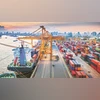
The Indian government last week banned ships flying Pakistani colours from docking at Indian ports. It also banned any imports from Pakistan, whether direct, indirect, or in-transit. However, the full impact of the import ban will only be felt later this week or early next week, given the transit times involved for indirect imports, especially from West Asian ports.
It takes about nine days for a ship from Dubai, the favoured port for goods originating from Pakistan for India to reach JNPT near Mumbai. The full impact of the import ban, imposed May 3 by the Director General of Foreign Trade (DGFT), will thus be felt by the coming weekend.
Meanwhile, the Central Board of Indirect Taxes and Customs (CBDTC), has ramped up eyes at key ports on India's western coast, principally JNPT. “The trade volumes are not considerable, but it will be necessary to ensure that not even one consignment slips through," a top-level officer with CBDTC told Business Standard, on conditon of anonymity.
About $10 billion of Indian exports reach Pakistan through trade rerouting via hubs such as Dubai, Singapore, and Colombo. This is around 15 per cent of Pakistan's total imports. But the corresponding exports from Pakistan to India is minimal.
Identity issues
The chief problem at JNPT is that the volume of consignments from the Middle East is quite large. Checking for Pakistani origins among the lot would be laborious. “Though the customs alert has been fed into the system, but given the varied levels of responsibility, those take a bit of time to percolate”, said a senior port official.
The orders by the DGFT on Saturday are part of a growing set of retaliatory measures by India in response to the massacre of 26 civilians, mostly tourists, at Pahalgam in Jammu and Kashmir, by terrorists believed to be backed by Pakistan. “This restriction is imposed in the interest of national security and public policy. Any exception to this prohibition shall require prior approval of the Government of India”, the DGFT circular said.
The process would have been even more time- and effort-consuming if the exports from Pakistan were large. For instance, trade at India’s eastern border with Bangladesh has a far larger volume. But as Pakistan exports only a small basket of goods like cotton bedsheets, towels, sports goods, rock salt, leather bags and purses, it will be presumably fairly easy for the officials to check for only those items.
The more immediate impact will be on exports from Afghanistan to India. The trade value between the two countries had reached close to $1 billion in FY25, after recovering from Afghanistan's civil war and the impact of Covid-19. All those have to be routed through sea routes, since India has also closed its Attari-Wagah checkpost. Afghanistan exports dried figs, asafoetida and its seeds, saffron, raisins, cumin, and almonds. Imports from India are value-added products like sugar, industrial materials, automobile parts, cotton products and a host of machinery items.
However, given the shipping ban, which uses powers under the Merchant Shipping Act, vessels with the Pakistan flag cannot enter Indian ports. This means that while port officials do not have any role in identifying the origin of the consignments, they still need to be careful. The onus of identifying goods from Pakistan rests squarely with the Customs officials, which is why their numbers on active duty have been enhanced.
“With the road and rail routes shut, the consignments from Pakistan can only operate via shipping or air routes The customs examiners have to be extra careful,” said a former customs department official.
At any port, it is the Customs officials who take charge of all goods brought in by a ship as per the manifest shown by the captain of the vessel. The consignments are offloaded into a customs area notified under the Customs Act. There, a Customs examiner begins his work. Engineering or electronic goods are examined for their origin, tallied with their descriptions, and then assessed for their value. For foodstuff or similar raw materials, the process is reversed. Their value is assessed and then checked or examined in a sample survey.
Customs preventive officers act as the spies, bringing in information about misclassification of goods for the examiners to seize upon.