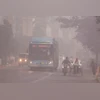
For several months of the year, the people in New Delhi, the pulsating heart and prestigious capital of India, and the urban agglomeration of thirty-three million people around it, live in an ‘open-air gas chamber’, as a former Chief Justice of India put it. At times, the darkness-at-noon quality of light can have an eerie, apocalyptic foreboding. The air quality routinely breaches hazardous levels of safety.
Yet, despite the tangible (health and other) costs, not just to the poor but the middle class and elite, particularly egregious for their children, being experienced in the now rather than in the future (as with climate change); despite there being no prospects for the influential elite to conveniently exit (as with other poorly provided government services such as water or education or health); despite India being the embarrassing focus of global attention; and despite the Supreme Court first passing orders in 1986, the air pollution problem has persisted for four decades with little prospect of resolution.
The expectation from us, as we look ahead at the end of this book, is to speak to Big Questions: will India become a developed country by 2047? Will India become a superpower? What are three critical reforms or actions that will propel India forward? And so on.
Instead, we would ask the more specific and pressing current question: will India be able to solve its air pollution problem? Mundane as it may seem, this is in some ways a metaphor for the challenges facing the nation more broadly. This is because its resolution will require cooperation between the Centre and the states affected by and culpable for the problem (Delhi, Punjab, Haryana, Rajasthan and Uttar Pradesh); cooperation amongst them; cooperation with India’s western neighbour (Pakistan) since winds do not respect political boundaries; addressing the long-standing problems of over-production of rice and its burning, which in turn will require reversing decades of bad policies such as the perverse incentives provided to rice- and wheat-growers in Punjab and Haryana; treading sagaciously around political issues related to identity and grievance — because Punjabi farmers are key protagonists — at a time when trust in the Centre as a credible interlocutor is low; and improving State capacity and more effective implementation of regulations to address the multiple causes of pollution, such as vehicle-related emissions, construction-related dust and solid-waste management. In short, if India cannot solve a problem that manifestly and acutely affects its elite, the prospects for solving the larger challenges confronting the country remain slim.
And, without doubt, there are plenty. In addition to the traditional and pressing ones of providing decent jobs for hundreds of millions, improving their health and education, reducing corruption and inequality, strengthening the State to deliver better services and reversing the decline in important institutions such as the judiciary, legislatures, media and the Election Commission, new challenges loom. Environmental damage to India’s soil, water supplies, forests and air has been considerable and risks setting back progress. Climate change will affect it disproportionately. The artificial intelligence (AI) revolution will create opportunities but can also threaten the country’s advantage in skilled labour and IT services, so that India might find itself with neither manufacturing nor services as the engine of growth.
We consider it a fool’s errand to produce a laundry list of ‘critical reforms’ to address challenges, old and new. Researching seventy-five years of Indian experience has instilled in us the understanding that there are no easy policy levers to pull because major changes have occurred through crises, shocks, shifts in ideas or the unpredictable consequences of rapid economic growth. Moreover, there is no objectively defensible way of establishing priorities. Improving health or education or State capacity or rule of law? Decriminalizing politics? Strengthening accountability? Restricting recourse to freebies that have spread like mutant viruses? Reducing inequality? Empowering women? Protecting marginalized groups? Breaking up Uttar Pradesh into smaller governable units?
And we are only too aware that any prescription for serious change runs up against the obvious and uncomfortable question: well, if they are so important and so prescription-worthy, why haven’t those reforms been implemented already? India — encompassing its unique and messy combination of State, society, market and politics — is a civilizational entity and, like the Titanic, slow to advance and impossible to dramatically alter its course. But alter course it must, else it might face the same fate. The reasons are manifestly evident as the world is being disrupted in very unpredictable ways.
***
The necessary conditions: Democracy and governance
While we do not want to prescribe a laundry list of all that’s needed, we can identify the necessary conditions that would give India a fair shot at solving the important challenges ahead and that, in the spirit of the Hippocratic oath, would ‘at least avoid harm’. In our opening chapter, we spoke about the wisdom of the Constituent Assembly which, while fully recognizing the burdens of history (evident in the clauses on reservations, for example), was acutely conscious that the Indian project must be forward-looking and therefore wore God, History and Identity lightly because each of them — unhelpfully backward-looking — could be toxic, even fatal, for democracy, order, a shared sense of nationhood and a workable federalism. And yet, these are the most serious dangers that loom ahead for India as, of course, they do for a world gripped by the consuming furies of nativism and illiberalism.
We have pointed out the many distinct early choices and their developmental consequences, including
the most critical, democracy. Notwithstanding the shadows democracy cast on India’s economic development at that early age of development, it was an inspired choice for nation-building and continues to be the most powerful glue holding the country together.
But democracy, like demography, is not destiny. The Achilles heel of India’s democracy has been the tattered accountability mechanisms permeating all aspects of life, from corruption to criminal behaviour, from exam leaks to encounter killings, from pollution to the police, from traffic accidents to riots.
Elections have become virtually the sole mechanism of accountability, and that massive overburdening has sharply inflated its stakes — and its costs. Electoral democracy has endured, even as a deeper democratic sensibility and what Nani Palkhivala (and before him Ambedkar) called ‘constitutional morality’ have eroded. They can only erode so far.
For all societies, the analogue to the ‘dark matter’ that keeps the universe together is civility, kindness and consideration, the invisible gravitational forces that maintain social cohesion. How that is weakening is perhaps best reflected in the virtual disappearance of the apostle of non-violence, Mahatma Gandhi, in the country he led to freedom, poignantly captured by the writer Krishna Kumar: ‘It’s time I said to Gandhi: Bye and thanks. I want to say, abide with me, but I don’t know where I might take him for comfort.’
Consequently, the weakening of democracy in India will inevitably weaken the nation-building project. If the Indian state weaponizes its own power or licences society’s vigilantism against particular communities, regions and individuals, if policymakers are obsessed with trawling and excavating for actual and imaginary temples under every mosque or litigating ad nauseam who should wear the legitimate mantle of past leaders, if the preoccupation of democratic politics is to conjure up new categories of sub-castes, or if the states in India raise the spectre of demographic engineering to retain the purity of their ‘native’ populations and eject migrants from other states, the idea and project of India will be fatally jeopardized.
Excerpted from “A Sixth Of Humanity: Independent India’s Development Odyssey” by Arvind Subramanian and Devesh Kapur with permission from HarperCollins