When Arvid Lindblad drifted the Red Bull RB8 into a tight arc of smoke at Moto Jam in Greater Noida on Sunday, it felt like a spectacle. But it was also a reminder of a longer story.
The event, held at the India Expo Centre & Mart, was built around high-octane exhibition — freestyle motocross, drifting and stunt runs. The centrepiece was a Formula One car, the RB8 that Sebastian Vettel drove to victory at the 2012 Indian Grand Prix, running on Indian soil again. At the wheel was Lindblad, confirmed to race full-time for Racing Bulls in 2026. Born to an Indian mother and Swedish father, and having spoken publicly about his pride in his Indian roots, he stepped out waving the tricolour ahead of his debut season.
Lindblad has described himself as “very proud” of his Indian heritage and the influence of his grandparents, saying he carries that identity with him as he steps onto the Formula One grid.
The timing matters because India’s own Formula One (F1) future is being discussed again.
Before Buddh: India’s first footholds in F1
India’s connection to Formula One did not begin with a home race.
Narain Karthikeyan became the first Indian to compete in Formula One in 2005, driving for Jordan Grand Prix, an independent Irish outfit founded by Eddie Jordan in 1991. By the time Karthikeyan joined, the team was operating with limited resources and would be sold at the end of that season, rebranding as Midland F1 in 2006. His entry was symbolic, but it came in machinery that was not competing at the front of the grid. He later returned for partial seasons in 2011 and 2012 with HRT, a Spanish-licensed new entrant that struggled financially and rarely contended beyond the back of the field.
Karun Chandhok followed in 2010, also with HRT. In 2011, he made select race appearances for Lotus Renault GP, the successor to the French manufacturer-backed Renault team that had previously won world championships with Fernando Alonso. Even then, his appearances were limited rather than a full-season drive.
Both careers reflected a structural reality. Indian drivers were entering Formula One through financially constrained or transitional teams rather than established manufacturer-backed systems. Without sustained domestic sponsorship pipelines or junior academy programmes feeding into top-tier outfits, longevity on the grid was difficult to secure.
The grid presence existed. The ecosystem did not.
Force India: Ownership without ecosystem
India’s former F1 star Karun Chandhok makes a return to the iconic Buddh International Circuit after 13 Years, with Sebastian Vettel’s 2012 RB8
If Karthikeyan and Chandhok represented India on the driver’s side, Force India carried the country’s name on the grid.
The team entered Formula One in 2008 after Indian businessman Vijay Mallya purchased the Spyker F1 outfit. Although branded as Indian, the team was based in Silverstone, England — like most modern F1 operations — and inherited the infrastructure of its predecessors. Over the next decade, Force India grew into one of the grid’s most efficient midfield teams, regularly finishing in the points and securing podium finishes.
Yet its identity remained commercial rather than developmental. The team did not operate from India, nor did it build a domestic pipeline feeding into Formula One. Its success was organisational and financial, not structural in terms of grassroots motorsport within the country.
In 2018, following financial distress, the team entered administration and was purchased by a consortium led by Canadian businessman Lawrence Stroll. It was rebranded as Racing Point for 2019 and 2020 before becoming Aston Martin in 2021.
With that transition, India’s name disappeared from the grid.
By the end of the 2010s, the country had lost both its race and its team identity in Formula One. What remained was an audience and a circuit — but no consistent structural foothold.
The Buddh years
The Buddh International Circuit opened in 2011 as a statement of ambition. Designed by Hermann Tilke and built at significant private cost by the Jaypee Group, it entered the F1 calendar at a moment when India was projecting global sporting confidence — from the Commonwealth Games to expanding international tournaments across disciplines.
The Indian Grand Prix ran from 2011 to 2013. Sebastian Vettel won all three editions. Attendance was strong, with the final race drawing an estimated 60,000 spectators on race day. Drivers praised the circuit’s elevation changes and technical layout.
Its disappearance was not due to lack of interest. It was economic.
Formula One was classified as “entertainment” rather than “sport” for tax purposes, triggering substantial liabilities. Hosting fees were widely reported between $30 million and $40 million annually. Combined with currency pressures and a sponsorship market still deepening, the structure proved unsustainable.
By 2014, India was off the calendar. The circuit remained. The race did not.
Revival moves to institutional levels
For years, discussion of F1’s return remained speculative. That conversation has shifted.
According to recent reports, the Adani group is exploring a resolution plan for Jaiprakash Associates that includes control of the Buddh circuit. Karan Adani has publicly indicated that he is personally engaged in exploring the possibility of bringing Formula One back to India as part of broader discussions around the future of the circuit.
Around the same time, Union Sports Minister Mansukh Mandaviya visited the circuit to assess the possibility of reviving global motorsport events there.
Mandaviya has signalled that the government would support the return of major international sporting events where commercially viable, framing the conversation in economic rather than symbolic terms.
There is no confirmed race. The conversation, however, is no longer nostalgic. It is institutional.
A different Formula One
The championship India exited in 2013 is not the one it would rejoin.
The calendar has expanded from 19 races then to 24 today. Team valuations have crossed the billion-dollar mark. Audi joins as a works manufacturer in 2026, while Cadillac will enter as an eleventh team. Under CEO Stefano Domenicali, the sport has deepened its commercial model and global footprint.
Hosting fees have risen accordingly, with several venues now paying upwards of $50 million annually. Any Indian return would require clarity on tax classification, promoter viability and long-term financial alignment that avoids the fragility of the previous stint.
The structural question is not whether India can stage a race. It already did. It is whether the economics can hold.
A new generation within the system Bengaluru's Kush Maini serves as a Test and Reserve Driver for Alpine in F1 while continuing his Formula 2 campaign
What distinguishes this moment from the post-2013 lull is India’s renewed presence inside the sport’s development structure.
Kush Maini, 24, born in Bengaluru into a racing family, represents that shift. The son of former racer Gautam Maini and younger brother of Arjun Maini, he emerged from India’s limited domestic circuit before moving to Europe to climb the junior ladder — the standard pathway for drivers from outside Formula One’s traditional centres.
Maini now serves as a Test and Reserve Driver for the Alpine Formula One Team, a works-backed operation based in Enstone, United Kingdom, while continuing to compete in the FIA Formula 2 Championship. As a reserve driver, he is integrated into Alpine’s simulator programme, development briefings and testing responsibilities, contributing to car set-up work and performance correlation alongside the race team.
That role is not ceremonial. In the cost-cap era, simulator and factory development work form a critical part of race preparation. Maini’s presence inside Alpine’s F1 structure places an Indian driver within the technical and operational core of a Formula One team for the first time in over a decade.
His competitive progression has been steady rather than sudden. After stints in British Formula 3 and FIA Formula 3, he stepped into Formula 2 — the final rung before Formula One — where budgets can exceed several million euros per season and margins are tight. Podiums and consistent points finishes have kept him in the conversation, but it is his Alpine integration that signals structural proximity to a race seat.
Maini has said India is “100 per cent ready” to host Formula One again, pointing to the country’s infrastructure and fan maturity since 2013. That view carries weight precisely because he operates within the system he believes India should reconnect with.
Lindblad’s elevation to a full-time Racing Bulls seat in 2026 adds another dimension. For the first time in over a decade, Indian-linked drivers are present within both the current grid and the development pipeline without a home race anchoring either.
That inversion is telling.
The long arc
Moto Jam was a spectacle. But it was also convergence.
An F1 car ran in Greater Noida while revival talks around Buddh resurfaced. A confirmed 2026 race driver with Indian heritage waved the tricolour days before his debut season. An Indian reserve driver works inside Alpine’s system. Corporate and government actors revisit the circuit question.
Individually, none of these guarantee a return. Collectively, they suggest India’s Formula One story is no longer static.
The country’s first F1 chapter lasted three years. Its absence has lasted more than a decade. If a second chapter begins, it will enter a different sport — larger, more expensive and more commercially structured — and a different India, one more deeply woven into the championship’s competitive fabric.
The smoke from Moto Jam cleared within minutes. Whether the alignment it reflects holds will determine if India’s second F1 chapter lasts longer than the first.


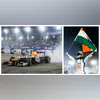 "F1 & India: Red Bull's Moto Jam, Lindblad and revival of unfinished chapter")


