Asteroids once ended the life of dinosaurs on earth, triggering an extinction level event that still haunts many people. There is a massive asteroid dubbed 99942 Apophis which is a near-Earth object (NEO) and it is believed that this may reach Earth in 2029. The size of the asteroid is 1,1100 feet or 335 metres in size, NASA confirmed.
The average distance between the Earth and the Moon is 239,000 miles and NASA reports that the asteroid 99942 Aposphis will be just 38,012 KM or 23,619 miles away from the Earth on April 14, 2029. Hence, it would be 10 times closer than the moon, and moving with a speed of 29.98 KM per second.
Will it strike Earth?
Many reports earlier claimed that the asteroid 99942 Apophis will strike Earth in 2029. This asteroid is one of the most hazardous since it was discovered in 2004. Nasa recently debunked such reports and clarified that a radar observation in March 2021 along with orbit analysis confirmed that the Apophis 2029 wouldn't hit Earth.
Davide Farnocchia of NASA’s Center for Near-Earth Object Studies (CNEOS) mentioned in the blog post that, “A 2068 impact is not in the realm of possibility anymore, and our calculations don’t show any impact risk for at least the next 100 years.” He referenced the Sentry Impact Risk Table maintained by CNEOS tracking asteroids that could potentially impact Earth. Recent findings revealed that there is no risk of Apophis and it has been removed from the Risk Table.
Can we watch the passing of Asteroid 99942 Apophis?
The asteroid will be very close to earth, and people will be able to have a glimpse of it from a safe distance. NASA said that the Apophis will be much closer than geosynchronous satellites on April 13, 2029. It will be visible to observers in the Eastern Hemisphere and they don't need any telescopes or binoculars. It is a rare opportunity for all astronomers to study the relic that has shifted from a potential threat to a subject of scientific interest.
Discovery of asteroid 99942 Apophis
Astronomers Roy Tucker, David Tholen, and Fabrizio Bernardi discovered the asteroid 99942 Apophis on June 19, 2004. They only managed to observe the asteroid for two days due to technical and weather problems. A team at the Siding Spring Observatory in Australia spotted the asteroid again later in the same year.
Since it was first observed, it has been tracked by optical and radar telescopes as it orbits the Sun and scientists are confident and aware of its future trajectory.
Nasa also redirected one of its spacecraft to study the asteroid after it completed its mission. The spacecraft aimed to collect samples of the Bennu asteroid in September 2023, OSIRIS-REx (Origins, Spectral Interpretation, Resource Identification, and Security – Regolith Explorer) was renamed OSIRIS-APophis EXplorer (OSIRIS-APEX). It was sent to study Apophys during the asteroid's 2029 Earth flyby.
How did Apophis get its name?
Apophis is named after the demon serpent who personified evil and chaos in ancient Egyptian mythology.
India should observe this asteroid, says Isro chief
While inaugurating a workshop on Planetary Defence for students at the ISRO headquarters, the Isro chief said, “India should be able to observe this asteroid...Discussions are in the process on how ISRO can contribute, maybe by preparing an instrument for the mission or providing other kinds of support for what is jointly being done by JAXA (Japan Aerospace Exploration Agency), ESA (European Space Agency) and NASA,”
He also mentioned that the impact of the asteroid can be disastrous and there is a need to prepare for planetary defence. If a 100-metre diameter object hits us, it can wipe out the entire nation. If a 2 km diameter hits the earth, the entire world could be destroyed.

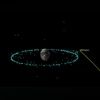 "Will Apophis hit Earth? Nasa debunk myth; here's all you need to know")


