In a breakthrough that could mark a major step in the search for life beyond Earth, scientists using the James Webb Space Telescope have identified gases in a distant planet’s atmosphere that, on Earth, are produced solely by biological processes.
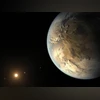
K2-18b, a planet located 124 light-years from Earth and orbiting a cool red dwarf star, had already intrigued astronomers with signs it may host a vast global ocean. Now, things have become even more compelling — researchers believe they’ve detected dimethyl sulfide (DMS) in its atmosphere. On Earth, this gas is only produced by living organisms, mainly tiny ocean-dwelling microbes like phytoplankton. There is no known non-biological source
While the discovery remains tentative, astronomers are eager to verify whether this potential biosignature stands up to further scrutiny.
This possible detection of a biosignature could be “potentially one of the biggest landmarks in the history of science,” said Nikku Madhusudhan, lead author of the new paper and astrophysicist at the University of Cambridge.
The researchers say their findings suggest K2-18b could be rich in microbial life. However, they are not claiming to have found living organisms just yet. Instead, they have identified a possible biosignature — a chemical clue that life-related processes might be occurring. They have emphasised the need for caution and further study before drawing any firm conclusions.
“This is the first time humanity has ever seen biosignature molecules — potential biosignature molecules, which are biosignatures on Earth — in the atmosphere of a habitable-zone planet,” Madhusudhan told reporters at a briefing.
He added that scientists are exploring several places within our solar system for signs of life, including Mars, Venus, and the icy moons of Jupiter and Saturn.
Where is K2-18b located?
K2-18b lies within our galaxy, the Milky Way, but cannot be seen as a discrete object through any telescope. The distant planet’s orbit crosses its parent star when viewed from Earth. As it transits, the planet dims the starlight slightly — and that light, when captured by powerful instruments like those on the James Webb Space Telescope, allows scientists to analyse changes in its spectrum and determine the gases present in the planet’s atmosphere.
K2-18b is 8.6 times as massive as Earth and has a diameter about 2.6 times larger. The planet orbits within the habitable zone of its star — the region where conditions could allow liquid water to exist, a vital ingredient for life. It circles a red dwarf star in the constellation Leo, about 124 light-years away. For context, a light-year is roughly 9.5 trillion kilometres. Scientists have also identified another planet orbiting the same star.
In a statement, Cambridge University noted that although an unknown chemical reaction could be behind the presence of these molecules on K2-18b, the findings represent the most compelling evidence so far that life might exist beyond our solar system.
What are Hycean worlds?
Since the 1990s, astronomers have discovered around 5,800 exoplanets — planets beyond our solar system. Among them, scientists have proposed the existence of “Hycean worlds” — planets covered in vast oceans and enveloped in hydrogen-rich atmospheres, potentially creating conditions suitable for microbial life.
Previous observations using the Webb telescope have revealed the presence of methane and carbon dioxide in K2-18b’s atmosphere. This was the first time carbon-based molecules were detected in the atmosphere of an exoplanet located within a star’s habitable zone.
“The only scenario that currently explains all the data obtained so far from JWST, including past and present observations, is one where K2-18b is a Hycean world teeming with life,” Madhusudhan was quoted as saying by Reuters.
“However, we need to be open and continue exploring other scenarios.”
According to him, if Hycean worlds do exist, they could host microbial life similar to that found in Earth’s oceans — perhaps even in warmer waters. When asked whether more complex or intelligent life forms might exist, he said it is too early to tell. For now, scientists believe that if such planets are habitable, they are most likely to support only simple microbes.

 "Webb telescope finds strongest clue yet of life beyond our solar system")

