
Apec leaders open summit after Trump-Xi move to ease trade tensions
The Apec region now faces challenges like strategic competitions between the US and China, supply chain vulnerabilities, aging populations and the impact of AI on jobs
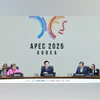 "Apec leaders open summit after Trump-Xi move to ease trade tensions")
WebinarsNew
Deep DiveNew
Explore Business Standard
The Apec region now faces challenges like strategic competitions between the US and China, supply chain vulnerabilities, aging populations and the impact of AI on jobs
Leaders of 21 Asian and Pacific Rim nations opened their annual summit Friday to discuss how to promote economic cooperation and tackle shared challenges, a day after President Donald Trump and Chinese President Xi Jinping agreed to take steps to ease their escalating trade war.
This year's two-day Asia-Pacific Economic Cooperation summit in the South Korean city of Gyeongju has been heavily overshadowed by Thursday's Trump-Xi meeting.
Trump described the meeting as a roaring success, saying he would cut tariffs on China, while Beijing had agreed to allow the export of rare earth elements and start buying American soybeans.
Their deals were a relief to the world economy, as experts previously warned that a failure to dial down trade tensions between the world's two largest economies were certain to deepen global economic uncertainties.
Established in 1989 during a period of increased globalisation, Apec represents more than half of global trade.
The forum champions free and open trade and investment to accelerate regional economic integration and has also been credited with bringing together countries embroiled in competitions to work together on common initiatives without binding statements.
The Apec region now faces challenges like strategic competitions between the US and China, supply chain vulnerabilities, aging populations and the impact of AI on jobs.
The US strategy has been shifted to economic competitions with China rather than cooperation, with Trump's tariff hikes and America first agenda shaking markets and threatening decades of globalisation and multinationalism.
Opening the summit as chair, South Korean President Lee Jae Myung called for greater cooperation and solidarity to overcome new challenges.
It's obvious that we can't always stand on the same side, as our nationals interest are at stake. But we can join together for the ultimate goal of shared prosperity," Lee said. I hope we will have candid and constructive discussions on how we can achieve Apec's vision in the face of the new challenge of a rapidly changing international economic environment." Trump left South Korea after his meeting with the Chinese president, and international media spotlight is now on Xi, whose government has portrayed itself as a defender of free trade and an alternative to US protectionism.
It's Xi's first visit to South Korea in 11 years, and he's scheduled to meet Lee and new Japanese Prime Minister new Japanese Prime Minister Sanae Takaichi separately on Friday.
Despite Trump's optimism after a 100-minute meeting with Xi, there continues to be the potential for major tensions between the countries, with both seeking dominant places in manufacturing and developing emerging technologies such as artificial intelligence.
It is certainly a contribution to bring the leaders of the two largest economies together for a meeting where they agreed to withdraw their most extreme tariff and export control threats. As a result, worst-case outcomes for global trade were averted, said Leif-Eric Easley, professor of international studies at Ewha Womans University in Seoul.
However, Apec is meant to be more than a venue for a trade war truce, Easley said. Greater multilateral efforts are needed to address the region's most pressing economic challenges, including resisting costly and destabilising protectionism, harmonising regulations for sustainable trade, and coordinating standards for digital innovation.
South Korean officials said they've been communicating with other countries to prod all 21 members to adopt a joint statement at the end of the summit so as not to repeat the failure to issue one in 2018 in Papua New Guinea due to US-China discord over trade.
South Korean Foreign Minister Cho Hyun said last week that issuing a joint statement strongly endorsing free trade would be unlikely because of differing positions among Apec members. He instead anticipated a broader declaration emphasising peace and prosperity in the region.
As host nation, South Korea places a priority on discussing AI cooperation and demographic challenges such as aging population and low birth rates, under the theme Building a Sustainable Tomorrow: Connect, Innovate, Prosper.
South Korean officials say Apec members will share exemplary cases of responses to AI and demographic issues, explore common steps and formulate new growth strategies during this week's summit.
(Only the headline and picture of this report may have been reworked by the Business Standard staff; the rest of the content is auto-generated from a syndicated feed.)
First Published: Oct 31 2025 | 11:34 AM IST

