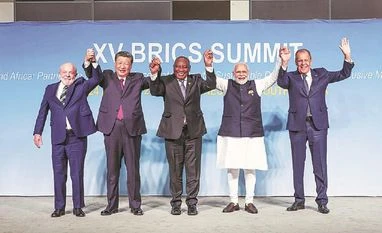
BRICS leaders on Thursday urged the international community to support countries working towards post pandemic economic recovery and address the high debt levels in some nations.
At the end of the BRICS Summit in South African capital, the grouping released the Johannesburg II Declaration that stressed on G20 -- a larger grouping of world's biggest economies -- playing the role of the premier multilateral forum to seek solutions to global challenges.
The leaders stressed on the importance of encouraging the use of local currencies in international trade and financial transactions, and sought strengthening of correspondent banking networks between the BRICS countries and enabling settlements in the local currencies.
They tasked finance ministers and central bank governors to consider the issue of local currencies, payment instruments and platforms.
"We recognise the important role of BRICS countries working together to deal with risks and challenges to the world economy in achieving global recovery and sustainable development," it said.
Recognising that BRICS countries produce one-third of the world's food, the leaders reaffirmed the commitment to strengthen agricultural cooperation and promote sustainable agriculture and rural development for enhancing food security.
The leaders were in favour of encouraging further cooperation among BRICS countries to enhance the inter-connectivity of supply chains and payment systems to promote trade and investment flows.
They reiterated commitment to strengthening the BRICS Contingent Reserve Arrangement (CRA), which acts as a mechanism for mitigating the effects of a crisis situation, complementing existing international financial and monetary arrangements, and contributing to the strengthening of the global financial safety net.
"We call on the international community to support countries in working together towards post pandemic economic recovery," it said.
"We emphasise the importance of contributing to post conflict countries' reconstruction and development and call upon the international community to assist countries in meeting their development goals."
The leaders noted "an unbalanced recovery" from the shock and hardship of the pandemic is aggravating inequality across the world.
"The global growth momentum has weakened, and the economic prospects have declined owing to trade fragmentation, prolonged high inflation, tighter global financial conditions, in particular the increase in interest rates in advanced economies, geopolitical tensions and increased debt vulnerabilities," the declaration said.
Noting that high debt levels in some countries are reducing fiscal space needed to address ongoing development challenges aggravated by spillover effects from external shocks, particularly from sharp monetary tightening in advanced economies, the leaders said rising interest rates and tighter financing conditions worsen debt vulnerabilities in many countries.
"We believe it is necessary to address the international debt agenda properly to support economic recovery and sustainable development," the declaration said.
"One of the instruments, amongst others, to collectively address debt vulnerabilities is through the predictable, orderly, timely and coordinated implementation of the G20 Common Framework for Debt Treatment, with the participation of official bilateral creditors, private creditors and multilateral development banks in line with the principle of joint action and fair burden-sharing," it said.
The leaders also favoured encouraging multilateral financial institutions and international organisations playing a constructive role in building global consensus on economic policies and preventing systemic risks of economic disruption and financial fragmentation.
They called for multilateral development banks to increase lending capacities while safeguarding long-term financial stability, robust creditor rating, and preferred creditor status.
"We believe that multilateral cooperation is essential to limit the risks stemming from geopolitical and geoeconomic fragmentation," the document said.
The leaders reaffirmed commitment to the promotion of an open, secure, stable, accessible and peaceful ICT-environment, underscored the importance of enhancing common understandings and intensifying cooperation in the use of ICTs and Internet.
They agreed to enhance international cooperation through collaborative information-sharing networks and mutual legal assistance to combat illicit financial flows, counter safe havens and support the investigation, prosecution and recovery of stolen assets subject to domestic laws and regulations of BRICS countries.
"We reaffirm our support for the open, transparent, fair, predictable, inclusive, equitable, non-discriminatory and rules-based multilateral trading system with the World Trade Organisation (WTO) at its core, with special and differential treatment (S&DT) for developing countries, including Least Developed Countries," it said.
The leaders committed to engage constructively to pursue the necessary WTO reform with a view to presenting concrete deliverables. "We call for the restoration of a fully and well-functioning two-tier binding WTO dispute settlement system accessible to all members by 2024, and the selection of new Appellate Body Members without further delay."
The BRICS leaders also called for the need to make progress towards the achievement of a fair and market-oriented agricultural trading system, ending hunger, achieving food security and improved nutrition, promoting sustainable agriculture and food systems, and implement resilient agricultural practices.
"We emphasise the need to deliver on agriculture reform in accordance with the mandate in Article 20 of the Agreement on Agriculture while recognising the importance of respecting the mandates with regards to a Permanent Solution on Public Stockholding (PSH) for food security purposes and Special Safeguard Mechanism (SSM) for developing countries, including LDCs, in their respective negotiating contexts," the declaration said.
BRICS members also expressed concerns over trade restrictive measures which are inconsistent with WTO rules, including unilateral illegal measures such as sanctions, that affect agricultural trade.
The leaders called for support for a robust global financial safety net with a quota-based and adequately resourced International Monetary Fund (IMF) at its centre.
"We call for the conclusion of the International Monetary Fund's (IMF) 16th General Review of Quotas before 15 December 2023. The review should restore the primary role of quotas in the IMF," it said, adding that any adjustment in quota shares should result in increases in the quota shares of emerging markets and developing economies while protecting the voice and representation of the poorest members.
The leaders also called for reform of the Bretton Woods institutions, including for a greater role for emerging markets and developing countries, including in leadership positions.


 "Brics calls for nations to work together on post pandemic economic recovery")

