China's 2024 lunar mission Chang'e-6 to carry payload from Pakistan
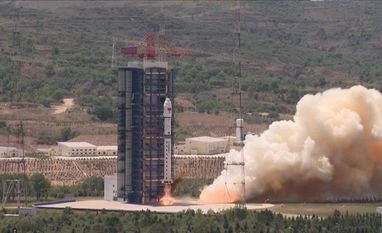
The Chang'e-6 lunar mission is currently undergoing research and development work as planned, state-run news agency Xinhua reported on Friday quoting China National Space Administration
Press Trust of India Beijing China's next lunar mission scheduled for 2024 will also carry a payload from Pakistan, the country's space agency has said, as the two all-weather friends step up their cooperation in the space sector.
The Chang'e-6 lunar mission is currently undergoing research and development work as planned, state-run news agency Xinhua reported on Friday quoting China National Space Administration (CNSA).
The Chang'e-6 mission, with the launch scheduled for around 2024, is tasked with bringing back samples from the far side of the moon. To date, all 10 lunar sampling missions conducted by humans have taken place on the near side of the moon, The Global Times newspaper reported.
The far side is generally older and contains the Aitken Basin, one of the three major lunar landforms, making it of significant scientific value, the report said, quoting CNSA.
The Chang'e-6 mission aims at landing the South Pole-Aitken Basin on the far side to explore and collect lunar samples from different regions and ages.
To promote international cooperation, the Chang'e-6 mission will carry payloads and satellite projects from different countries and regions - France's DORN radon detection instrument, the European Space Agency's negative ion detector, Italy's laser retroreflector, and Pakistan's CubeSat, the CNSA said.
A CubeSat is a miniaturised satellite from Pakistan. Earlier this year, Pakistan also sent seeds to the Chinese space station, Tiangong, for research into environmentally tolerant seeds. Similarly, Pakistan is exploring the possibility of a formal agreement to join both the Tiangong space station, as well as the more ambitious China-led base on the lunar South Pole, the Dawn newspaper reported last month.
The lunar far side is the side that faces away from the Earth and is sometimes also called "the dark side of the Moon" because so little is known about it.
To support the communications between the moon's far side and the Earth, China plans to launch its newly developed relay satellite Queqiao-2, or Magpie Bridge-2, in the first half of 2024, the Xinhua report said.
(Only the headline and picture of this report may have been reworked by the Business Standard staff; the rest of the content is auto-generated from a syndicated feed.)


 "China's 2024 lunar mission Chang'e-6 to carry payload from Pakistan")

