By Julian E Barnes and Helene Cooper
The targeted strikes on Iran being considered by the Trump administration would probably be aimed at nuclear and missile sites in the country. But the president has yet to specify, to either the American people or the troops who would carry out his orders, exactly what he wants this military engagement to accomplish.
In his State of the Union speech on Tuesday, President Trump appeared to suggest a goal — that Iran needs to say the “secret words” that it will never have a nuclear weapon. But Iran has already essentially made that promise, even if it has enriched enough uranium to make intelligence officials scoff.
US officials say they doubt that Iran is ready to make a deal, but that the strategy behind targeted strikes would be to force its leaders to make concessions.
More immediately, the objective would be to damage Iran’s nuclear and missile facilities.
Mr. Trump declared that Iran’s three most important nuclear sites were “obliterated” in US strikes last year. They were not obliterated, but they are not operational either, according to officials who have reviewed the intelligence.
For Israel, the most critical immediate threat is Iran’s missiles. Destroying them would limit the country’s ability to retaliate against Israel and military bases in the region that house US troops. American military officials say that while their bombers and Tomahawks can significantly damage Iran’s missiles, it could manufacture more. And Iran has spread out some of its launch sites, making an attack more difficult.
But any damage from a US strike would more likely serve two symbolic purposes. Several administration officials said it would allow Mr. Trump to claim a military victory against an old foe. But top officials also hope it would drive Iran to give up its nuclear enrichment program, although some current and former officials doubt whether it would accomplish that.
Gen. Dan Caine, the chairman of the Joint Chiefs of Staff, has said in Situation Room meetings that while the US forces amassed in the Middle East could carry out small or medium strikes, there would be a potentially high risk of American casualties and a negative effect on American weapons stockpiles.
“When we initiate contact, we should expect Iran to launch 100 missiles at US bases, because that was what they did to Israel in June,” said Maj. Gen. Paul D. Eaton, a retired Army veteran of the war in Iraq. American troops, he added, have neither Israel’s vaunted Iron Dome air defense system nor its vast bunker network that helped keep casualties down during the country’s armed conflict with Iran last June.
Mr. Trump, General Eaton said, “has failed to make the case to the American people for why we are conducting this war of choice.”
Critics of Mr. Trump also say that if he intends to attack, he needs to articulate a clear objective and seek congressional authorization.
“The president has not explained why now is the moment for another war in the Middle East,” said Representative Jim Himes of Connecticut, the top Democrat on the House Intelligence Committee. “If anything, he has done the opposite by continuing to insist publicly that previous strikes ‘obliterated’ the Iranian nuclear sites.”
Senator Jack Reed of Rhode Island, the top Democrat on the Armed Services Committee, said in an interview that there was a performative element to much of the president’s foreign policy-making. “He hopes that when he starts the performance the other side will quickly say, ‘We give up, let’s settle this,’” Mr. Reed said. When they don’t, the president simply declares victory and moves on, Mr. Reed said.
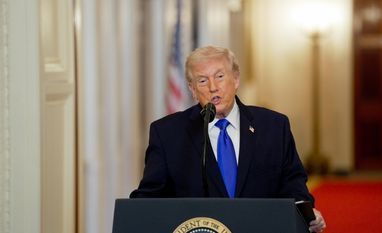
In his address on Tuesday, Mr. Trump said his preference was to solve the issue diplomatically. “We are in negotiations with them. They want to make a deal,” he said, without explaining what kind of agreement his administration was trying to reach.
Analysts have noted that Iran is in a weak position but appears unlikely to make a diplomatic deal, given how much it has invested in its nuclear program.
“It is unlikely that Iran is going to accede to President Trump’s demands and give up its nuclear program,” said Joseph Zacks, a former senior C.I.A. officer and an adjunct fellow at the Foundation for Defense of Democracies. “We are likely headed to a military confrontation.”
Should discussions in Geneva on Thursday fail to result in any consequential progress, Mr. Zacks said that there was a possibility of an initial limited strike to demonstrate to the Iranian government America’s “seriousness of purpose in order to propel the regime to understand the gravity of its intransigence and return to the negotiating table.”
But Mr. Zacks predicted that any sort of limited strike would probably have the opposite effect and harden the Iranian position, adding that it was “not in the supreme leader’s DNA to make concessions on the Iranian nuclear program” that went beyond the deal reached during the Obama administration. Mr. Trump withdrew the United States from that agreement during his first term.
Privately, some senior administration officials are skeptical that diplomacy will work, prompting a debate over what military option would most effectively force Iran to make a deal on its nuclear program.
The Trump administration has debated two plans. One would be a major strike aimed at hitting a huge number of targets over a sustained period of time. Critically, it would also try to decapitate the government by forcing the supreme leader, Ayatollah Ali Khamenei, from power.
But Mr. Trump seems to favor a targeted, limited strike on the missile and nuclear sites. The purpose, in addition to damaging missile stocks and production, would be to force the Iranians to negotiate.
American officials have said that if Iran did not accept their demands after a targeted strike, Mr. Trump would then consider the larger strike as a follow-on mission.
But two US military officials said that despite the administration’s military buildup in the region, the Pentagon does not have the forces or munitions needed for an extended bombing campaign. Seven to 10 days, one of the officials said, is about how long the American military positioned in the region could continue strikes.
Some officials have warned that any strike would probably unleash an outsized response from Iran.
A series of intelligence reports in recent weeks raised the possibility that Iran could order its proxies to attack US targets if the United States or Israel strike Iran. Some officials noted that Iran’s response to the US nuclear strike last year was relatively restrained — but that may not be the case this time, if the Iranian government determines its limited retaliation failed to deter American aggression.
In meetings on Iran, General Caine and John Ratcliffe, the C.I.A. director, provided options and intelligence to the president and his advisers. But, to the frustration of some of Mr. Trump’s advisers, the discussions have centered more on tactics than on the broader strategy the administration is trying to pursue.
The United States has long assessed that the supreme leader will not be willing to give up Iran’s nuclear program, and that the more Iran is attacked by the United States, the more likely he is to believe his country’s best defense will be to get a nuclear weapon.
Mr. Trump’s speech Tuesday night succinctly captured the extent of the president’s thinking and planning on Iran, one official said.
“One thing is certain, I will never allow the world’s No. 1 sponsor of terror, which they are by far, to have a nuclear weapon,” Mr. Trump said. “Can’t let that happen.”
That, the official said, is the president’s military aim in Iran.

 "For Trump, military strikes in Iran could serve symbolic purpose")


