French President
Emmanuel Macron publicly corrected
Donald Trump on Monday over the extent of Europe’s financial aid to Ukraine, ensuring transparency over the narratives surrounding the war.
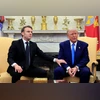
During a joint press conference in the White House, Trump sought to justify his push for a new agreement that would secure US access to Ukraine’s mineral revenues, claiming that Europe was merely offering Ukraine loans rather than direct financial support.
“Just so you understand, Europe is loaning the money to Ukraine. They’re getting their money back,” Trump stated.
Macron immediately interrupted, reaching over to touch Trump’s arm in a rare display of direct fact-checking during a high-profile diplomatic event.
“No, in fact, to be frank, we paid. We paid 60 per cent of the total effort. It was like the US: loans, guarantees, grants,” Macron asserted.
Trump, caught off guard, offered a rueful smile but did not challenge Macron’s statement. The moment was critical as it showed long-standing US-European tensions over financial and military support for Ukraine, with Trump having repeatedly accused Europe of not contributing enough to Kyiv’s defence.
Europe’s support for Ukraine
Macron’s pushback comes amid renewed European efforts to strengthen support for Ukraine, particularly as Trump re-emerges on the global stage with his transactional approach to foreign policy. The French president has been a vocal advocate for ensuring Moscow faces consequences for its aggression, insisting that any peace deal must include strong security guarantees to prevent further Russian incursions.
While the European Union and its member states have committed billions in military aid, humanitarian support, and reconstruction funding, Trump has consistently suggested that the financial burden falls disproportionately on the US. Macron’s on-the-spot correction sought to counter that narrative, reaffirming Europe’s leading role in the collective response.
US-European divergence on Ukraine
The exchange highlighted the growing divide between Trump’s vision for Ukraine’s future and that of European leaders. Trump, who has refrained from calling Vladimir Putin an aggressor, has instead focused on brokering a deal—one that he claims could end the war within weeks. However, his willingness to negotiate with Moscow without strong preconditions has raised concerns among European allies.
Despite their differences, Trump signalled openness to a European-led peacekeeping force in Ukraine, an idea he plans to discuss further when he meets UK Prime Minister Keir Starmer later this week. He also claimed that Putin was open to the concept, though details remain vague. Trump also reaffirmed his desire to meet Ukrainian President Volodymyr Zelensky soon, as he pushes for an agreement that would secure US economic interests in Ukraine.
“It looks like we’re getting very close,” Trump said, suggesting that an end to the war could come within weeks.
Tensions over Russia in the G7
The meeting followed a virtual Group of Seven (G7) summit, where US officials had pushed back against including the phrase ‘Russian aggression’ in the final communique. Trump also renewed his controversial call for Russia to be reinstated in the G7, a stance that has drawn resistance from European leaders, including Macron.
Standing beside Trump at a joint press conference, Macron was clear in his stance. “We want peace. He wants peace,” Macron said, referring to Trump. “We want peace swiftly, but we don’t want an agreement that is weak. This peace must not mean a surrender of Ukraine.”
Trump, however, avoided any mention of security guarantees, instead touting his negotiating skills. “I’ve spoken to President Putin, and my people are dealing with him constantly,” Trump said. “That’s what I do. I do deals. My whole life is deals.”

 "Watch: Macron fact-checks Trump in real time on European aid to Ukraine")


