India likely to resist Pakistan's bid to be a full-fledged member of Brics

Pakistan has sought Russia's help to become a member during its Brics presidency which began on Monday with the motto of "Strengthening Multilateralism for Equitable Global Development and Security"

Brics
Asit Ranjan Mishra
4 min read Last Updated : Jan 02 2024 | 11:24 PM IST
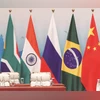
India is likely to resist Pakistan’s bid to be a full-fledged member of Brics (Brazil, Russia, India, China, South Africa) because it wants to keep it a grouping for emerging market economies. Pakistan has sought Russia’s help to become a member during its Brics presidency, which began on Monday with the motto “Strengthening Multilateralism for Equitable Global Development and Security”.

“Of course we will resist Pakistan’s candidature for Brics as its character as a grouping for emerging market economies shouldn’t be lost. If we take all and sundry, then that character will be lost. Pakistan will not contribute anything to Brics and political issues will creep in, though bilateral issues are not allowed to be discussed in Brics forums. Since a decision on adding new members is based on a consensus, we are confident of thwarting Pakistan’s move,” a senior government official said.

Taking over the baton of Brics presidency on January 1, Russian President Vladimir Putin said Russia would work on the modalities of a new category of Brics partner countries. “We will consider the degree to which many other countries, about 30 of them, are prepared to join the Brics multidimensional agenda in one form or another. To this end, we will start working on the modalities of a new category of Brics partner countries,” he added.

On January 1, Egypt, Ethiopia, Iran, Saudi Arabia, and the United Arab Emirates joined Brics, making it a 10-member bloc, while Argentina has pulled out of its plans to join the grouping. India and Pakistan are members of the South Asian Association for Regional Cooperation (Saarc) and Shanghai Cooperation Organisation (SCO). While Saarc has remained dysfunctional mainly due to differences between India and Pakistan, both South Asian neighbours recently squabbled at SCO meetings.

The 19th Saarc Summit, which was scheduled to be held in Pakistan in 2016, was postponed after India, Afghanistan, Bhutan, Bangladesh, and Sri Lanka decided to boycott the event. 

The subsequent summits have not taken place due to the inability to reach a consensus on a venue.

During India’s presidency of the SCO last year, External Affairs Minister S Jaishankar and his Pakistan counterpart Bilawal Bhutto Zardari were engaged in heated exchanges on terrorism and India abolishing the special status of Jammu and Kashmir. While Bhutto Zardari put the onus on India to create a conducive environment for bilateral talks, Jaishankar took strong exception to that, calling him the “spokesperson for a terrorism industry”.

“Victims of terrorism do not sit together with its perpetrators to discuss terrorism,” Jaishankar said at the SCO foreign ministers’ meet held in Goa in May last year.

Bilateral relations between the two neighbouring countries deteriorated after India revoked the special status of Jammu and Kashmir in August 2019 by removing Sections of Article 370. Subsequently, the Imran Khan government suspended all kinds of trade with India.

India in February 2019 had withdrawn the most-favoured-nation (MFN) status for Pakistan and imposed a 200 per cent tariff on all imports from the country after the Pulwama terror attack. But it didn’t ban either exports or imports to Pakistan.

While trade between the two countries stood at $2.6 billion in FY19 before disruption, it plunged to $647 million in FY23. There were negligible imports by India from Pakistan.

The Tussle

Pakistan has sought Russia’s help to become a member during the Kremlin's BRICS presidency, which began this year
India has opposed Pakistan's entry as it wants to keep Brics a group for emerging market economies 
The decision to add new members is based on the Group's consensus
Egypt, Ethiopia, Iran, Saudi Arabia, and the UAE joined the Brics grouping this year


One subscription. Two world-class reads.

Already subscribed? Log in

Subscribe to read the full story →
*Subscribe to Business Standard digital and get complimentary access to The New York Times

Smart Quarterly

₹900

3 Months

₹300/Month

SAVE 25%

Smart Essential

₹2,700

1 Year

₹225/Month

SAVE 46%
*Complimentary New York Times access for the 2nd year will be given after 12 months

Super Saver

₹3,900

2 Years

₹162/Month

Subscribe

Renews automatically, cancel anytime

Here’s what’s included in our digital subscription plans

Exclusive premium stories online

  • Over 30 premium stories daily, handpicked by our editors

Complimentary Access to The New York Times

  • News, Games, Cooking, Audio, Wirecutter & The Athletic

Business Standard Epaper

  • Digital replica of our daily newspaper — with options to read, save, and share

Curated Newsletters

  • Insights on markets, finance, politics, tech, and more delivered to your inbox

Market Analysis & Investment Insights

  • In-depth market analysis & insights with access to The Smart Investor

Archives

  • Repository of articles and publications dating back to 1997

Ad-free Reading

  • Uninterrupted reading experience with no advertisements

Seamless Access Across All Devices

  • Access Business Standard across devices — mobile, tablet, or PC, via web or app

Topics :Vladimir PutinBRICSIndiaPakistan RussiaBRICS Summit

Next Story





