
India-Nepal border forces hold annual talks, discuss 'mutual issues'
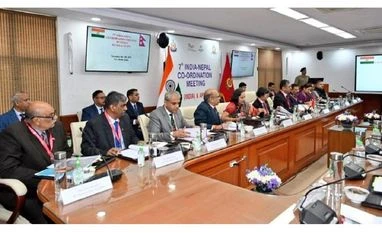
A nine-member delegation led by Raju Aryal attended the first day of the meeting being held at the SSB Headquarters
 "India-Nepal border forces hold annual talks, discuss 'mutual issues'")
WebinarsNew
Deep DiveNew
Explore Business Standard
A nine-member delegation led by Raju Aryal attended the first day of the meeting being held at the SSB Headquarters
The border guarding forces of India and Nepal discussed "mutual issues" in the three-day annual meeting that started here in the national capital on Monday.
Being held between November 6 and November 8, the 7th India-Nepal Coordination Meeting will discuss measures to curb trans-frontier crimes and timely sharing of intelligence inputs, among other issues too, an official said.
The seventh edition of the annual coordination talks between the two countries is led by India's Sashastra Seema Bal (SSB) Director General Rashmi Shukla and the visiting inspector general of the Armed Police Force (APF) of Nepal, Raju Aryal.
A nine-member delegation led by Raju Aryal attended the first day of the meeting being held at the SSB Headquarters.
As per the SSB, "discussions on mutual issues held in meeting"-- annual talks that have been held alternatively in India and Nepal since 2012.
This annual meet is significant as the heads of the SSB and the APF engage in discussions on border-related matters that includes trans-border crimes and intelligence sharing. The meeting also helps in strengthening coordination between the two border guarding forces for more effective management of the open and unfenced India-Nepal border.
Besides mutual issues, both the SSB and the APF are expected to raise other issues such as effective border management, new mechanism to collaboratively combat trans-border crimes, facilitation of on-time information, exchange of critical information among their troops.
The last coordination meeting between the two border guarding forces was held at Kathmandu in September 2022.
Working under Union Ministry of Home Affairs, the SSB is responsible to guard the 1,751 km India-Nepal open international border.
The 'open' border between India and Nepal is established under the Treaty of Peace and Friendship, which the two countries signed in 1950.
Provisions within the treaty give citizens of both the countries equal rights in matters of residence, acquisition of property and employment, and movement in each other's territory. As per these provisions, the citizens of India and Nepal can cross their shared borders without passport and visa restrictions.
(Only the headline and picture of this report may have been reworked by the Business Standard staff; the rest of the content is auto-generated from a syndicated feed.)
First Published: Nov 06 2023 | 3:28 PM IST


 Connect with us on WhatsApp