Interstellar comet 3I/ATLAS spotted: Updates on status, position and speed
Astronomers and space agencies continue to track the interstellar comet 3I/ATLAS streaking through solar system at blistering speeds
Yunus Dar New Delhi A rare visitor from beyond the stars is making headlines — astronomers have confirmed the arrival of comet 3I/ATLAS, only the third known interstellar object to pass through our solar system. First spotted by astronomers on 1 July 2025, this icy wanderer is travelling at staggering speeds and offers a rare glimpse into the mysterious world beyond our Sun’s reach.
Spotted by the ATLAS telescope in Río Hurtado, Chile, the object’s unusual, hyperbolic trajectory immediately set off alarms among astronomers. Global observations soon confirmed what many suspected: this icy wanderer didn’t originate here.
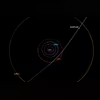
Now racing through space at an astonishing 60 km/s, 3I/ATLAS is currently about 670 million kilometres from the Sun and is expected to make its closest approach — still a safe 240 million kilometres from Earth — in late October 2025. Estimated to be as wide as 20 kilometres, the comet is set to offer a rare scientific opportunity, and a stunning reminder that our Solar System is not as isolated as it once seemed.
How far is interstellar comet 3I/ATLAS from Earth right now?
As of now, comet 3I/ATLAS (C/2025 N1) is about 509 million kilometres away from Earth. That’s roughly 3.4 times the distance between Earth and the Sun. To put it in perspective, light from the comet takes about 28 minutes and 20 seconds to reach us — offering a glimpse into just how far this rare interstellar visitor truly is.
When will comet 3I/ATLAS come closest to Earth?
Comet 3I/ATLAS (C/2025 N1) is estimated to make its closest approach to Earth on 19 December 2025. On that day, it will still be a safe distance away — about 269 million kilometres from our planet, or roughly 1.8 times the distance between Earth and the Sun. This will be its nearest point to Earth during the entire 21st century.
Where did 3I/ATLAS come from?
The newly discovered interstellar object, 3I/ATLAS, is believed to have originated in a distant star system, where it was likely ejected by gravitational forces into the vast emptiness of interstellar space. After drifting for millions — possibly even billions — of years, it has finally entered our Solar System. Astronomers say it’s approaching from the direction of the constellation Sagittarius, which lies near the heart of our Milky Way galaxy. When first detected, 3I/ATLAS was around 670 million kilometres from the Sun, placing it just inside Jupiter’s orbit.
How bright is comet 3I/ATLAS?
Comet 3I/ATLAS (C/2025 N1) currently has a visual magnitude of 17.73, which makes it extremely faint. At this brightness level, it’s not visible to the naked eye and can only be seen using long-exposure photography or powerful telescopes.
How fast is comet 3I/ATLAS moving?
Extremely fast. When it was first discovered, comet 3I/ATLAS was hurtling through space at about 137,000 miles per hour (or 221,000 kilometres per hour). That’s roughly 61 kilometres per second — and it’s expected to pick up even more speed as it gets closer to the Sun.

 "Interstellar comet 3I/ATLAS spotted: Updates on status, position and speed")


 Connect with us on WhatsApp