
Nasa spacecraft successfully 'pings' Chandrayaan-3 Vikram lander on Moon
The lander was 100 kilometers away from LRO, near Manzinus crater in the Moon's south pole region, when LRO transmitted laser pulses toward it on December 12 last year
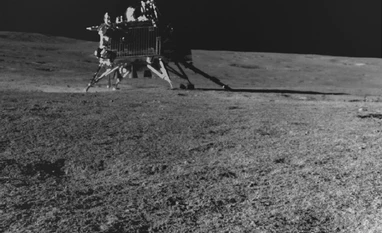 "Nasa spacecraft successfully 'pings' Chandrayaan-3 Vikram lander on Moon")
WebinarsNew
Deep DiveNew
Explore Business Standard
The lander was 100 kilometers away from LRO, near Manzinus crater in the Moon's south pole region, when LRO transmitted laser pulses toward it on December 12 last year
Laser instrument onboard a NASA spacecraft orbiting the Moon has successfully pinged the Vikram lander of India's Chandrayaan-3 mission, the US space agency said.
The laser beam was transmitted and reflected between the Lunar Reconnaissance Orbiter (LRO) and an Oreo-sized device on Vikram lander, opening the door to a new style of precisely locating targets on the Moon's surface, NASA said.
The lander was 100 kilometers away from LRO, near Manzinus crater in the Moon's south pole region, when LRO transmitted laser pulses toward it on December 12 last year.
After the orbiter registered light that had bounced back from a tiny NASA retroreflector aboard Vikram, NASA scientists knew their technique had finally worked.
Sending laser pulses towards an object and measuring how long it takes the light to bounce back is a commonly used way to track the locations of Earth-orbiting satellites from the ground.
However, using the technique in reverseto send laser pulses from a moving spacecraft to a stationary one to determine its precise locationhas many applications at the Moon, scientists said.
"We've showed that we can locate our retroreflector on the surface from the Moon's orbit," said Xiaoli Sun, who led the team at NASA's Goddard Space Flight Center, that developed the retroreflector on Vikram as part of a partnership between NASA and Indian Space Research Organization (ISRO).
"The next step is to improve the technique so that it can become routine for missions that want to use these retroreflectors in the future," Sun said in a NASA statement.
Only 2 inches, or 5 centimeters, wide, NASA's tiny but mighty retroreflector, called a Laser Retroreflector Array, has eight quartz-corner-cube prisms set into a dome-shaped aluminum frame.
The device is simple and durable, scientists say, requiring neither power nor maintenance, and can last for decades. Its configuration allows the retroreflector to reflect light coming in from any direction back to its source, NASA said.
Retroreflectors can be used for many applications in science and exploration and have been in use at the Moon since the Apollo era.
By reflecting light back to Earth, the suitcase-size retroreflectors revealed that the Moon is moving away from our planet at a rate of 3.8 centimeters per year, the US space agency added.
Reacting to the development, ISRO said the Laser Retroreflector Array (LRA) on the Chandrayaan-3 lander has begun serving as a fiducial point (precisely located markers for reference) on the Moon.
"NASA's Lunar Reconnaissance Orbiter (LRO) achieved a laser range measurement using the LRA by successfully detecting signals reflected by it on December 12, 2023. The ranging utilized the Lunar Orbiter Laser Altimeter (LOLA) on the LRO. The observation occurred during lunar night time, with the LRO ascending to the east of Chandrayaan-3," the Indian space agency added.
(Only the headline and picture of this report may have been reworked by the Business Standard staff; the rest of the content is auto-generated from a syndicated feed.)
First Published: Jan 22 2024 | 3:45 PM IST

