Chen Ning Yang, a Nobel Prize-winning physicist who gave up his US citizenship to become a citizen of China in 2015 and helped persuade other scientists to do the same, passed away. He was 103.
Yang died of illness on Saturday in Beijing, according to a statement posted on the Tsinghua University website.
The Nobel Prize Committee in 1957 recognized Yang and fellow physicist Tsung-Dao Lee, both of whom were born in China and later became naturalized US citizens, for their work on the violation of the parity law in weak interactions. Up until the publication of the pair’s paper a year earlier, physicists had long assumed that particles would act the same when mirrored, a theory Yang and Lee showed to be misplaced.
Never before had someone of Chinese descent won a Nobel Prize.
“My most important contribution in life is helping change Chinese people’s psychology of feeling inferior to others,” Yang is quoted as saying on the cover of a 2000 book collecting his various writings.
Yang left China for the US in 1946 to attend the University of Chicago on a scholarship, earning his doctorate two years later. Among the faculty who praised Yang at Chicago was Nobel laureate Enrico Fermi, who recommended him to Julius Robert Oppenheimer, the father of the atomic bomb, who was at the time director of the Institute for Advanced Study at Princeton University.
At Oppenheimer’s invitation, Yang joined the institute and worked there for 17 years, crossing paths with scientists such as Albert Einstein and Freeman Dyson. Oppenheimer later described Yang’s work as demonstrating “great imaginativeness and basic conceptual simplicity, as well as considerable analytic power. It is also characterized by a good taste, restraint, and critical judgment, quite remarkable in so young a scientist.”
To facilitate his work in the US, Yang became an American citizen in 1964. He said the decision was “painful” and one he came to regret, because his father, even on his deathbed, refused to forgive him.
Yang reversed that decision in 2015, when he renounced his US citizenship and became a citizen of China. “The US is a beautiful country and a country that gave me very good opportunity on conducting scientific research,” Yang said of the choice. “I am grateful to the US.”
He said the blood in his veins was his father’s and “belonged to the Chinese culture.”
Professor’s Son
Born on Sept. 22, 1922, in the eastern city of Hefei, capital of Anhui province, Yang spent most of his childhood on the campus of Tsinghua University in Beijing, where his University of Chicago-educated father, Yang Ko Chuen, was a professor of mathematics.
Yang climbed every tree and studied every blade of grass on the university compound, he recalled in a 2005 speech.
After Japan invaded China in the 1930s, Yang moved with his family almost 2,000 miles away to the southwestern province of Yunnan. He earned a bachelor’s degree from National Southwestern Associated University in 1942 and a master’s from Tsinghua University in 1944, before his move to the US.
In 1954, Yang and Robert Mills formulated the Yang-Mills Non-Abelian Gauge Theory to explain interactions between nuclear particles. The model “synthesizes the physical laws of nature and provides us with an understanding of the fundamental forces of the universe,” the Franklin Institute said in its citation when presenting Yang the 1994 Bower Award and Prize for Achievement in Science.
In 1971, Yang was the first prominent Chinese American scholar to visit China after the US lifted a travel ban. When Chinese leader Deng Xiaoping visited the US in January 1979 to mark the start of official bilateral ties, Yang delivered a speech at a welcoming banquet hosted by Chinese Americans.
Special Duty
In those remarks, Yang said that Chinese Americans, rooted in two cultures, shouldered a special duty to enhance understanding between the countries, according to a documentary produced by the state-owned broadcaster China Central Television.
Yang became more involved in bolstering China’s scientific capabilities in years after that.
In 1997, when Tsinghua University established its own Institute for Advanced Study, Yang was named an honorary director. He moved full-time back to China in 2003, taking on research work and teaching at Tsinghua. At the age of 82, Yang taught general physics to four freshman classes, according to a 2017 article by Zhu Bangfen, a Tsinghua physics professor.
Yang persuaded other scientists to follow his path. The most prominent of them was Andrew Chi-Chih Yao, a top computer scientist and winner of the A.M. Turing Award, who became a professor at Tsinghua’s Institute for Advanced Study in 2004, thanks in part to a push from Yang. Yao, who counts among his former students the founders of some of China’s most-promising AI startups, later also gave up his US citizenship in 2015, according to a report in the journal Science.
But efforts to recruit US-educated scientists to China, such as with the Thousand Talents program, also fueled American suspicions that Beijing was attempting to appropriate cutting-edge technology. In 2018, President Donald Trump’s administration started the what it called the China Initiative, to investigate and prosecute Chinese and Chinese-American researchers it said were stealing American secrets. That initiative would be ended in 2022 after coming under intense criticism for fanning discrimination.
While Yang never publicly expressed his views on the rivalry between Washington and Beijing or its impact on scientific cooperation, he was conscious of the inherent tension even as a young man accepting the Nobel Prize some seven decades earlier.
In his acceptance speech, Yang described himself as feeling “in more than one sense a product of both the Chinese and Western cultures, in harmony and in conflict.”

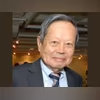 "Nobel laureate Chen Ning Yang, pioneer in particle physics, dies at 103")


