Home / World News / 6 intelligence leaks that shook the US: Latest Yemen breach joins the list
6 intelligence leaks that shook the US: Latest Yemen breach joins the list
From war plans to surveillance secrets, America's biggest intelligence leaks have exposed military strategies, covert operations, and government cover-ups
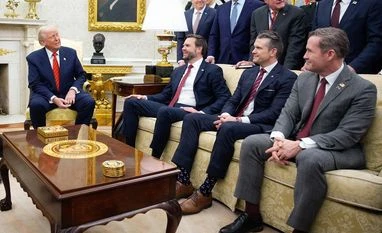
Donald Trump, from left, JD Vance, Pete Hegseth, and Michael Waltz during a meeting in the Oval Office of the White House in Washington, DC | Image: Bloomberg
A casual conversation among top US officials in a private messaging group turned into one of the most damaging intelligence leaks in recent history. It exposed US military strategies, weapon shipments, and covert operations against Houthi militia in Yemen, sending shockwaves through the defence and intelligence community.
How the leak happened
Senior officials from the Trump administration mistakenly added Jeffrey Goldberg, the editor-in-chief of The Atlantic, to a private Signal group chat. Unbeknownst to them, Goldberg gained real-time access to classified military discussions. Seizing the moment, he later published the details, bringing sensitive US military plans into the public domain.
Now dubbed the Yemen War Plan Leak, this breach ranks among the most significant intelligence failures in US history, joining the likes of the Pentagon Papers, Edward Snowden’s NSA revelations, and WikiLeaks disclosures.
Here are six major intelligence leaks in US history:
The Hutchinson letters (1772)
Before the US won independence, Benjamin Franklin leaked letters from Massachusetts Governor Thomas Hutchinson, which revealed the governor’s push for a stronger British military presence in American colonies. This revelation fuelled growing revolutionary sentiments and deepened public distrust in colonial leadership.
The Pentagon papers (1971)
Daniel Ellsberg, a military analyst at the RAND Corporation, leaked a top-secret government report showing how US officials had misled the public about the Vietnam War. Published by The New York Times, the Pentagon Papers exposed decades of deception. Although Ellsberg faced espionage charges, the case was dismissed in 1973. He is now regarded as a pivotal figure in the history of government transparency.
WikiLeaks documents (2010)
US Army intelligence analyst Chelsea Manning leaked thousands of classified military and diplomatic documents to WikiLeaks, revealing shocking details of civilian casualties in Iraq and Afghanistan, and human rights violations. Among the most infamous disclosures was a classified video showing a US Apache helicopter attacking and killing 12 civilians, including two Reuters journalists. Manning was sentenced to 35 years in prison but was later pardoned by former US President Barack Obama in 2017 after serving seven years.
NSA leaks (2013)
Former NSA contractor Edward Snowden exposed the US government’s vast surveillance programs, revealing that intelligence agencies were secretly collecting citizens’ phone data on a global scale. His leaks, published by The Guardian and The Washington Post, triggered worldwide debates on privacy and government overreach. Charged with espionage, Snowden fled to Russia, where he remains in exile, advocating for digital privacy rights and press freedom.
Russia election leak (2017)
National Security Agency (NSA) translator Reality Winner leaked a classified intelligence report detailing Russian interference in the 2016 US election. She shared the document with The Intercept, believing that the public deserved to know the truth. Investigators quickly traced the leak back to her, leading to her arrest and a prison sentence of more than four years. Her story later inspired the 2023 film Reality, starring Sydney Sweeney, which closely follows the real FBI interrogation transcript from her arrest.
Watergate scandal (1972-1974)
Though not a conventional intelligence leak, the Watergate scandal remains one of the most infamous US government cover-ups in history. Investigative journalists exposed illegal activities, including the break-in at the Democratic National Committee headquarters and subsequent cover-ups by former President Richard Nixon’s administration. The relentless reporting ultimately led to Nixon’s resignation.

 "6 intelligence leaks that shook the US: Latest Yemen breach joins the list")

