


Busy women: Are women's contributions at home and work truly recognised?
Shinjini Kumar's book asks whether women's contributions within and outside home are being recognised and understood. The answers are surprising
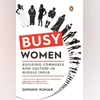 "Busy Women: Building Commerce and Culture in Middle India")
premium
Busy Women: Building Commerce and Culture in Middle India
4 min read Last Updated : Feb 10 2026 | 10:54 PM IST
Listen to This Article
Busy Women: Building Commerce and Culture in Middle India
by Shinjini Kumar
Published by Penguin
340 pages ₹699
Shinjini Kumar’s debut book is a timely work of narrative nonfiction that reframes contemporary India’s economic story through women’s lives beyond the bustling metros. Based on extensive travel over three years across more than 30 cities and interviews of over 300 women, the book combines field reporting with economic insight to examine how women as economic actors actively shape local markets, institutions and urban life in Middle India’s Tier 2 and Tier 3 cities, such as Jaipur, Lucknow, Darjeeling, Patna, Bhopal and Surat. “It is amazing how invisible women are when you look for them in the regular data or ask around the regular people,” writes Ms Kumar.
A former central banker, regulator and finance professional, Ms Kumar’s journey started off with a train ride to Nagpur, where she met a young woman entrepreneur and Shark Tank winner. This led her to meet more than 30 women in Nagpur itself, each with interesting stories to tell. Thereafter, she went to Raipur, Bhubaneshwar and Dehradun, reaching out to women’s organisations, industry groups and friends — collecting personal histories of several women along the way — and that was how the book kept growing. “I don’t think I had ever paid attention to the number of women who, consciously or subconsciously, combine work, home, business and social responsibility,” she writes.
Throughout the book, Ms Kumar meets a mix of women in these cities, comprising culture entrepreneurs, startup founders, shop owners, bakers, café owners, software exporters, Anganwadi workers, homestay owners, designers, models and consultants. Further, she meets women who run family-owned enterprises, boutiques, art galleries, preschools, handicraft businesses, travel companies, jewellery ventures, food brands and heritage hotels. “I was inspired by travel and conversations in middle-class drawing rooms, shops, factories, offices or households as the setting for de-layering commerce and gender relations,” writes Ms Kumar in the Prologue.
What is heartening is that most of the women featured in the book are married, and several with children too — which is why it’s great to read examples of how well they are able to balance work with family life, even in the country’s smaller cities and towns. In a sense, these are all women who are smashing patriarchy in small-town India. “Women are known to give credit, even when they do not owe it,” notes Ms Kumar, who believes that women have to work harder than men, given all their other household and family responsibilities.
The question that the author set out to decipher was whether women’s contribution within and outside home is being recognised and understood, or undermined and broad-brushed under age-old stereotypes. What she found is that most cultural activities in the towns and cities that she visited were helmed by women, whether in the area of heritage, restoration, craft, textile or design. “Their contribution is the easiest to dismiss, but it always falls upon the elite to lead cultural change,” she writes.
Along the way, Ms Kumar makes some important observations about various changes taking place in Indian society over the years, such as increasing instances of inheritance by daughters. “Acceptance of patriarchy on their own behalf is easier than accepting it for their daughters,” she explains. Further, more daughters are now choosing to build upon their families’ legacies. “This phenomenon is a bigger enabler of change than we recognise and possibly the most important vector to close the gender gap in wealth and power,” Ms Kumar writes. The book also throws light on the recent trend of an increasing number of young people returning to Tier 2 and Tier 3 cities where they belong after some years of education or work in bigger cities or abroad.
Through the stories of these women and their work, the book in many ways is also about the change that has taken place in the Indian economy over the last three decades. It is, in a sense, the story of India today, particularly its growing small towns, where the entrepreneurial ecosystem is thriving, the startup culture is gaining steady momentum, and there are ample opportunities for mentorship and collaboration. Moreover, the story of a new India where women are building fulfilling careers, their work is being recognised, accepted, and in some cases, even taking centre stage.
“The future of India’s growth will indeed depend on how we grow beyond our Tier 1 cities and where our new resources of talent and capital — entrepreneurial, cultural, social — will come from, what will they be deployed to do and who will they include in the march to the future,” Ms Kumar concludes.
The reviewer is a New Delhi-based freelance writer
Topics : BOOK REVIEW Book reading BS Reads Book