


The living mountains: Anuradha Roy's intimate portrait of life in the hills
Anuradha Roy's Called by the Hills is a luminous, reflective memoir of building a life in the Himalayas-where gardens, memories and ecology quietly intertwine
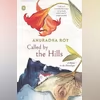 "Called by the Hills: A Home in the Himalaya")
premium
Called by the Hills: A Home in the Himalaya
4 min read Last Updated : Jan 02 2026 | 10:59 PM IST
Listen to This Article
Called by the Hills: A Home in the Himalaya
Written by Anuradha Roy
Published by Hachette India
166 pages, ₹999
The best book lists of 2025 are now well and truly everywhere, an eye-watering array of colourful literary candy, like a forest in full bloom, making you wish you had managed to read just a few more this year. Acclaimed author Anuradha Roy’s first work of non-fiction would be a worthy addition to anyone’s holiday reading.
Twenty-five years ago, Roy and her husband, both of whom work in publishing, left Delhi to build a quiet life in the hills of Ranikhet, having stumbled upon a crumbling cottage on the estate of their publisher friend Ravi Dayal. They bravely set out to bring it back to life, despite all manner of creatures, missing carpenters, and the slow pace of the hills.
Called by the Hills is a fine collection of personal essays that carries a misty Himalayan lightness, offering an escape from the year’s heaviness. For anyone who has even fleetingly considered a home in the mountains, here’s an intimate portrait, featuring the peaks and troughs of a life lived there. In turns, wry, gentle, and moving, Roy strings together these fragments in evocative prose, as the couple learns to negotiate a tricky and enchanting terrain as permanent residents.
This is a handsomely produced hardback, with the author’s own artwork punctuating chapters. A collection of beautiful colour postcards and bookmarks featuring her watercolour paintings come tucked into an envelope attached to the back cover. A portrait of the modest, red-roofed white cottage on a sloping hill on the cover is where the heart of the book resides, and what follows are glimpses of luminous snow peaks stretching across the sky, mountain dogs striking a pose, birds aflutter, and flowers of every kind in bloom. Though not a trained artist, Roy’s artwork is an immediate draw, as it invites you to visualise a place in time long before you take in the words.
It was during the pandemic that Roy’s fiction publisher, Christopher MacLehose, suggested she write a book on the Himalayas, “specifically its flowers so that imprisoned readers could wander in imagined gardens far away,” she writes. It certainly succeeds in doing that, and more.
Although the author does not consider herself a botanical expert, she has a keen eye, a sharp ear, and a deep curiosity for the flora surrounding her in the hills. The book, though, is a far more expansive literary excursion than initially intended, as Roy found she could “not separate the garden from all that went on around it”.
And so we get lived-in tales about not just botanical experiments, but the vibrant fauna — freely roaming leopards, unwelcome leeches, all variety of bird calls, friendly dogs — as well as the experience of city people finding their feet in the natural world, and the chilling effects of global warming on the ecology.
Roy’s lens highlights micro moments, with days moving in slow motion. She also writes about growing up as the child of a geologist, spending long stretches in tents, an experience that instilled in her a lifelong resolve never to sleep in one again.
Each chapter works as a piece of studied reflection, a deft patchwork of memories and learnings. In “Accidental Lodging”, Roy takes us behind the scenes of the reconstruction of her home, at a time when the internet was “stuff of fantasy” and mobile phones had not made their way up the mountains. In the amusing “The Ancient”, she ventures into character study, specifically of Ama, who came with the house, a knowing, sometimes unnerving presence, hovering over Roy as she worked on her garden. Many chapters feature the surrounding community into which the author gradually finds herself embedded — over flowers, jams, books, and conversations — from local shop owners, quirky neighbours, to well-regarded scholarly folk. Dogs, the writing life, books on mountains are threads that run through the book. Living in nature, Roy is also confronted with questions of existence and ecosystems, with seasons increasingly muddled, snow peaks balding, human-wild conflicts rising. She considers what it means to be a presence there but not interfere with natural systems, such as the implications of hanging artfully-made, lovingly-filled bird feeders, something naturalists caution her against. The dilemma unsettles her, but she understands, even as she watches the birds disappear after the winter party — shortening each year — comes to an end. Her role as witness — and storyteller — stands strong.
The reviewer is an independent journalist
Topics : Himalaya BOOK REVIEW Book reading BS Reads