


Tata Sons board meet next week likely to steer leadership dialogue
Tata Trusts, the largest shareholder of Tata Sons, had last year passed a resolution recommending a third term for N Chandrasekaran
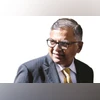 "N Chandrasekaran, Chairman, TCS")
premium
N Chandrasekaran, Chairman, Tata Sons
4 min read Last Updated : Feb 17 2026 | 11:21 PM IST
Listen to This Article
The Tata Sons board meeting, coming up next week, could be crucial for the future of the salt-to-semiconductor conglomerate. With a year to go before chairman N Chandrasekaran’s second term ends, approval for his third five-year term is likely to be taken up by the Tata Sons board on February 24.
Tata Trusts, the largest shareholder of Tata Sons, had last year passed a resolution recommending a third term for Chandrasekaran (or Chandra as he’s popularly known). At that meeting, Tata Trusts chairman Noel Tata and vice-chairman Venu Srinivasan are learnt to have put forward the proposal to renew Chandra’s term for another five years as executive chairman of Tata Sons.
When renewal of his term comes up at the Tata Sons board, Chandra, 62, would have to recuse himself from the discussion, a source said. In 2022, when Chandra’s term was renewed, then Tata Trusts chairman and chairman emeritus of the group Ratan Tata had attended the Tata Sons board meeting as a “special invitee’’ and had recommended his name for another five years.
An extraordinary general meeting (EGM) of shareholders is usually convened within days of a board approval of this nature.
Tata Sons did not respond to a Business Standard questionnaire on renewal of Chandra’s term and how it may play out for the business including some of the ambitious ventures of the group such as iPhone manufacturing, semiconductor facility, EV battery plant and ecommerce.
Chandra took the leadership charge at the holding company of the Tata group on February 21, 2017, four months after Cyrus Mistry was removed from that role. Once the Tata Sons board approves Chandra’s renewal, he’s expected to continue to lead the group till at least 2032. Within the Tata group, executives typically superannuate at 65, while those in non-executive roles can go up to 70. By recommending another renewal for Chandra as executive chairman, who will be 68 at the end of his third term, Tata Trusts is learnt to have favoured continuity during the group’s business transformation.
A source said that an age relaxation for executive roles is expected at the time of Chandra’s renewal, while pointing out that the same was done when Ratan Tata took the executive role for a while following Cyrus Mistry’s removal.
A renewal of Chandra’s term may also bring clarity to the issue of listing of Tata Sons, people in the know suggested. Tata Trusts has maintained that Tata Sons should be kept out of the ambit of public listing. Tata Sons was designated an upper layer non banking financial company by RBI in September 2022, mandating a stock market listing of Tata Sons within three years. The RBI has not responded to the Tatas’ request seeking a change in classification from an upper layer core investment company. And Tata Sons has remained silent on the way forward.
Besides the relatively new businesses and the listing issue, the Tata group has faced some other headwinds recently, especially the Air India crash of June 12, 2025, and disruption at TCS.
R Gopalakrishnan, industry watcher, commentator, author and a long-time Tata Insider said: ‘’Tata Group has had long-serving chairmen—Jamsetji Tata (36 years), Dorabji Tata (28 years), JRD Tata (52 years), Ratan Tata (23 years). Only Nowroji Saklatwala (seven years) and Cyrus Mistry (four years) were exceptions.’’ According to Gopalakrishnan, while multi-decadal service is surely considered too long by modern standards, 15 years for Chandra will be great for ‘’value-driven continuity and top-class execution’’.
Responding to what Chandra’s third term may mean for the Tata Group, Thomas Mathew, a former bureaucrat, corporate strategist and author of Ratan Tata: A Life, expects Chandra’s next five years to be just like Ratan Tata’s after 10 years as chairman. He told this newspaper: ‘’For the first ten years, for both, it has been about identifying new areas of growth, outlining strategies, and implementing them. The next five years will see the realisation of these strategies and mark a period of higher growth for the Tata Group as a whole…’’
In a yearend letter to the employees of the Tatas in December 2025, Chandra signalled his vision for the group. As volatility becomes the new constant, bold risk-taking and not caution will define who succeeds, he said while highlighting the importance of investment for the long-term even amid volatility.
Topics : Tata Trusts N Chandrasekaran Tata group Ratan Tata