


India's startups build humanoids with local code, globally sourced hardware
Indian robotics startups are developing humanoid and quadruped robots using locally built software while relying on global supply chains for critical hardware, as deployments steadily rise
 "Robots, Humanoid, Dog")
premium
Humanoids continue to remain a niche category of robots
4 min read Last Updated : Dec 24 2025 | 6:04 PM IST
Listen to This Article
A group of school students is drawn to a large tent on IIT Bombay’s campus, where a line-up of supercars and superbikes is on display. It is not these gleaming machines that hold them in awe, though.
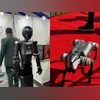
Instead, their attention is fixed on a quadruped robot confidently weaving through the crowd, greeting them and drawing laughter as it jumps and waves its front legs while balancing steadily on its rear ones.
Beyond entertainment, quadruped robots or robodogs are proving their value in real-world applications such as security and surveillance, exploration, and search-and-rescue operations, particularly in environments where human access is limited or unsafe.
As the name goes, these are stable autonomous or semi-autonomous robots with four legs, a set of sensors to map and understand the environment, a processing unit and batteries.
“These work best in areas that are hazardous by human standards or industrial areas where human intervention is risky. Humanoids, quadrupeds, or drones (underwater and air) are still manufactured in China, whereas a bunch of complex programming and code can be done locally,” said Fahad Baig, business manager, XBoom, a Bengaluru-based robotics firm.
Startups showcasing their robots at the university’s TechFest said much of the hardware continues to be sourced from markets such as China and Switzerland, supply chains that have previously posed challenges, particularly during the pandemic.
Take a humanoid, for instance. It is a robot designed to mimic human form and movement, enabling it to perform tasks ranging from lifting light to medium loads to surveillance, inspection, and precision sorting, among others.
To build one, companies turn to countries like China that are known for most of the robot’s hardware composition such as actuators, motors, battery, thrusters, among others.
Switzerland is a sourcing market for high-precision sensors, they said.
“When we source models from China, we get access to multiple SDKs (software development kits) that can be customised to our liking from a software-perspective. The lack of research and development (R&D) in India is forcing everyone to look elsewhere to procure hardware components,” a technical lead at a startup, which sells humanoids, said.
Humanoids continue to remain a niche category of robots.
A 2025 report by The International Federation of Robots (IFR) stated that few commercial deployments were announced yet, with true multipurpose humanoids still away.
The focus on humanoids continued to remain at the R&D stage, with manufacturing still reliant on demand-based purchases. However, companies continue to build prototypes for trial applications.
However, this does not deter homegrown startups from building humanoid versions. Apart from XBoom, which is building humanoids at its Bengaluru facility, Pune-based Muks Robotics is also building two different humanoid models with distinct test use cases. Muks claims to be completely bootstrapped, funding development on its own currently.
“We are building most of the humanoid locally except for parts such as motors that have to be imported. The LLM on the humanoid is also run locally and based on open source code,” said Anshu Jain, a technical product manager at the company.
Jain explained that its humanoid model Spaceo M1 had an arm payload capacity of 1 kg each, with it being tested to lift luggage. This humanoid model was capable of carrying 50 kg on its trolley.
While humanoid deployment continues to remain a niche category for the Indian robotics sector, the deployment of industrial robots has continued to grow over the past few years.
In 2024, 9,123 such robots were installed in India, growing from 8,510 in the previous year. In the past decade, the number has more than quadrupled from 2,126 deployments, according to IFR data.
In comparison, the US saw around 34,000 industrial robotic deployments in 2024, down 9 per cent from approximately 38,000 in 2023. In 2014, the deployments were recorded at 26,000.
Topics : robot dog humanoid robots start- ups