Draft guidelines prepared by the ministry said the scheme would provide government support for water metro projects implemented through fully government-funded and public-private partnership modes. The scheme will run until 2036-2037.
The scheme will target regions with inherent geographic suitability, including the presence of navigable waterways, availability of continuous or semi-continuous navigable circuits capable of supporting scheduled services and hydrological conditions that allow safe and reliable operations, including manageability of seasonal variations.
The Inland Waterways Authority of India (IWAI) commissioned feasibility studies for water metro systems in 18 cities in February last year. These cities were selected based on factors such as urban scale, navigable waterways, and existing ferry usage.
According to the ministry, each project is estimated to cost between ₹800 crore and ₹1,300 crore. Echoing concerns highlighted in the Economic Survey, the ministry said that rising urbanisation is placing rising pressure on urban transport infrastructure.
“The predominant effects of this trend can be seen in the form of rising motorisation rates, wherein total registered motor vehicles in India grew at an average annual rate of approx.9.8 per cent between 2012 and 2022, reaching 226 million vehicles by 2023 and projected to hit 494 million by 2050. This surge has given rise to various negative externalities like road congestion, air pollution, and road fatalities,” it said.
Vessels procured for water metro systems will be green — electric or hybrid — and indigenously designed and built by Indian shipyards to promote the domestic shipbuilding industry. “Aggregation of demand through standardised designs and bulk procurement is encouraged to achieve economies of scale, negotiate competitive costs, and progressively enhance localisation of the components across the Water Metro ecosystem,” it said.
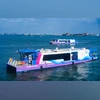
The government plans to develop these metro systems in four models ranging from complete government funding to a public private partnership mode. The contours of the scheme have been designed with the reference of Kerala’s Kochi Water Metro.
The plan lays out a special provision for viability gap funding for projects which may need that kind of support. A city-level Special Purpose Vehicle (SPV) will be constituted jointly by the central and state governments for the purpose of implementing the approved projects, the ministry said.


 "kerala water metro")