


India-US ties: First tranche of trade deal to be negotiated over 7-8 months
Experts upbeat as this comes after Trump's comments on India being the 'biggest tariff abuser'
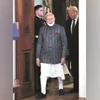 "Prime Minister Narendra Modi arrives for a joint press conference with US President Donald Trump at the White House Photo: Reuters")
premium
Prime Minister Narendra Modi arrives for a joint press conference with US President Donald Trump at the White House Photo: Reuters
4 min read Last Updated : Feb 14 2025 | 11:32 PM IST
Listen to This Article
India and the United States (US) have agreed to negotiate the first tranche of a ‘mutually-beneficial multi-sector bilateral trade agreement’ over the next seven-eight months.
Experts see this as a way to address the American President’s incessant comments on India being the “biggest tariff abuser”.
Both the countries will hold talks for increasing market access, reducing tariff and non-tariff barriers, and deepening supply chain integration, said the joint statement released after Prime Minister Narendra Modi and US President Donald Trump’s meeting at the White House.
The proposed trade deal will be in line with the ‘bold new goal’ set by Modi and Trump to more than double the bilateral trade to $500 billion by 2030.
The announcement came hours after Trump unveiled a plan to impose “reciprocal” tariffs on US trading partners to narrow its ‘large and persistent’ annual trade deficit in goods and tackle other “unfair and unbalanced aspects” of trade.
An announcement on tariffs and its details is expected after April 1.
Foreign secretary Vikram Misri said that during the bilateral talks between Modi and Trump, the issue on tariff came up quite ‘normally’.
“They both had their perspectives, but what is more remarkable or what is worth looking at is that we have a way forward on this issue in terms of the undertaking to discuss or start discussions on a bilateral trading agreement. This may actually be a very good opportunity to take forward and conclude something which was actually foreseen in the first Trump administration,” Misri told reporters at a briefing in Washington.
This is not the first time that India and the US are trying to seal a trade agreement. During Trump’s first term ending January 2021, India held extensive discussions with the US on a limited trade agreement but issues were not resolved.
The deal was expected to enable import tariff cuts for US dairy products, communication and technology products and greater market access to certain medical devices.
In return, India was bargaining hard for restoration of its beneficiary status under the US Generalized System of Preferences (GSP) program or zero-duty benefits to Indian exporters, among other things.
Even as bureaucrats remained optimistic, trade experts warned about the feasibility of a bilateral trade deal with the US.
Biswajit Dhar, distinguished professor at Council for Social Development said unlike other countries, the US was the only major economy with whom we were not able to come to an agreement on negotiating a mandate for a free trade deal due to serious differences.
“We need to ensure that our core interests — agriculture, intellectual property rights and access to food — are not compromised. India is also rebuilding the manufacturing sector. We have adopted an autonomous tariff policy to support manufacturing. Any trade partner that we engage with should also respect the sovereign right India has to develop its manufacturing,” Dhar.
He added that India should be able to speak its mind regarding this.
Ajay Srivastava, former trade official and founder of Delhi-based think tank GTRI said while Modi and Trump talked about a trade agreement soon, the details remain unclear.
It could be a limited deal on reciprocal tariffs, expected to be announced in April.
Going ahead, steps will be taken to increase import of industrial goods from the US and export of manufactured products to Washington. The two sides will also work together to increase trade in agricultural goods, the joint statement said.
Ajay Sahai, director-general (DG) and chief executive officer (CEO), Federation of Indian Export Organisations (FIEO), said although ambitious, a bilateral trade target of $500 billion is achievable as India is looking to increase manufacturing trade services with the US.
“The economic landscape has changed a lot (since 2018 when the mini trade deal talks with the US began). As far as the bilateral trade deal is concerned, we hope to gain tariff concessions on existing as well as potential exports. That apart, Indian companies’ competitiveness has also gone up,” Sahai said.
An overview of key trade-related developments
- 2018: Under Trump, India imposed higher import duty on 30 products, including motorcycles, machines, agri products
- 2019: Washington withdrew Generalised System of Preferences or zero-duty benefits to Indian exporters worth $5.6 billion
- Jan 2021: India and the US failed to finalise a mini trade deal by the end of Trump’s first term
- Nov 2021: Under Joe Biden, India and the US revived the Trade Policy Forum (TPF) after four years
- 2022: India and the US became a part of plurilateral groupings
- 2023: Both countries resolved seven pending disputes
- 2024: Both the nations identified mutually beneficial areas to develop a forward-looking roadmap for enhanced cooperation