


Hospitals prepare for emergencies; Aiims, others cancel leave of employees
Centre and state-run hospitals ramp up emergency preparedness amid India-Pakistan conflict with drills, stockpiling, coordination, and deployment of mobile facilities
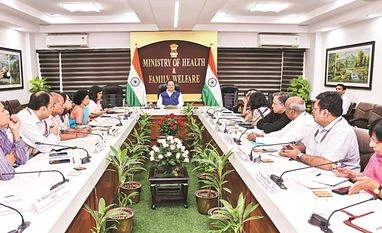 "Union Health Minister J P Nadda during a meeting with senior officials of the ministry to review health infrastructure preparedness across hospitals in New Delhi on Friday | Photo: PTI")
premium
Union Health Minister J P Nadda during a meeting with senior officials of the ministry to review health infrastructure preparedness across hospitals in New Delhi on Friday | Photo: PTI
4 min read Last Updated : May 09 2025 | 11:53 PM IST
Listen to This Article
Hospitals across India are readying for emergencies that may arise due to the heightened India-Pakistan tensions. The Union Health ministry on Friday held a high-level review meeting to assess the preparedness.
At the review meeting, Union Health Minister J P Nadda directed all states to ensure that medical emergency response health systems are adequately equipped and functional at all times. He was emphatic about ground level linkages with state governments at the district level for immediate emergency healthcare.
While Centre-run hospitals have started undertaking mock drills and training programmes for essential staff and doctors, private facilities too have activated their emergency preparedness protocols.
A spokesperson for the All India Institute of Medical Sciences (Aiims), New Delhi, said a mass casualty management mock drill was conducted at the facility. Aiims also confirmed that leave of all doctors and essential staff had been cancelled. Other Central government hospitals and health facilities would follow a similar drill. New Delhi Municipal Council (NDMC) and Municipal Corporation of Delhi (MCD) have also ordered their employees not to go on leave in view of the current situation.
Hospitals and medical institutions have been advised to ensure availability of essential drugs, adequate supply of blood, oxygen and trauma care kits.
“They have also been asked to coordinate with state and district administration, armed forces and regional associations of doctors, nurses, paramedics, private sector hospitals and charitable institutions, to strengthen the emergency response networks in a collaborative manner,” the health ministry said.
In other locations, especially close to the border areas, hospitals were getting into the emergency mode.
A representative of Fortis Hospital in Amritsar, which is just 30 km away from the international border, told Business Standard that the hospital had activated emergency preparedness protocols. “In compliance with International Red Cross guidelines, a Red Cross has been clearly marked on the hospital rooftop to aid in aerial identification during emergencies,” he said.
In such a situation, the protocol includes reservation of select beds for emergency admissions, mobilisation of rapid response teams, and stocking critical drugs, medical consumables as well as blood bank resources.
A wholesale distributor of medicines in Jammu said while there were no supply disruptions as of now, they were apprehensive in case the conflict dragged on for more time.
“J&K has seen landslides which stopped movement of goods. With Jammu being targeted in the shelling, a combined effect on the supply of medicines can only be gauged in the next two to three days,” a Jammu-based distributor said.
According to Ravindra Sankhala, principal specialist, Shri Jawahir Government District Hospital, Jaisalmer, multiple mock drills have been conducted in the facility including siren alerts, immediate deployment of emergency response teams, and formation of dedicated teams comprising four doctors and ten officers to handle small scale casualties.
Similar drills were conducted in the premier central hospitals such as PGIMER, Chandigarh, and JIPMER, Puducherry.
Portable and mobile healthcare facilities called Bharat Health Initiative for Sahyog Hita and Maitri (BHISHM) cubes have been dispatched to Poonch and Rajouri districts of Jammu and Kashmir, while Aiims Jammu has been asked to accept all referral patients coming from these areas.
Apart from the border states, other hospitals in major cities such as Mumbai have also started getting ready for any eventuality. Joy Chakraborty, COO of PD Hinduja Hospital, Mumbai, said there would be a training with civil defence officials for the staff.
George Alex, Western India Regional Business Head at HealthCare Global Enterprises (HCG), said their facilities in Colaba and Borivalli in Mumbai were actively conducting internal drills focused on the safe and efficient transfer of patients. "In addition, we have reinforced our alternate backup power systems to remain fully operational during extended power outages. Our teams are also undergoing disaster management protocol drills, including patient triage procedures, to strengthen our readiness for both internal and external disasters," he added.
In prep mode
> Hospitals advised to ensure availability of essential drugs, adequate supply of blood, oxygen
> Aiims New Delhi mobilised doctors and nurses with supplies for ready deployment
> Ram Manohar Lohia Hospital in New Delhi expected to cancel leaves of doctors
> Fortis Hospital in Amritsar activates emergency preparedness protocols
(With inputs from Sohini Das and Anjali Singh)