


 "Air pollution, Delhi")
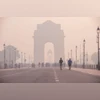
As Delhi once again grapples with its annual air pollution malaise, Congress MP Manickam Tagore on Thursday demanded that the Indian government borrow from Beijing’s playbook to tackle the crisis.
Raising the matter during Zero Hour in the Lok Sabha, Tagore accused the Centre of failing to enforce existing rules or establish clear lines of accountability despite repeated episodes of hazardous smog. “This is not just an environmental crisis, it is a human crisis. When people are choking with polluted air, no nation can call itself developed,” he said.
The Congress MP pointed out that China’s capital, once among the world’s most polluted cities, had managed to engineer a dramatic turnaround by setting clear deadlines, embracing clean mobility, and cracking down on major pollution sources.
“I demand an immediate time-bound, Beijing-style clean air emergency plan,” Tagore said, recommending stronger penalties for violators and faster electrification of public transport.
Also Read

 "Umar Khalid")
 "Modi Trump")
 "B Park, president and CEO of Samsung Southwest Asia")
 "indigo airlines, indigo")
 "indian coast guard, pakistani boat, indian waters")
How did Beijing clean up its toxic air?
Beijing was once widely known as the “smog capital of the world”, with its air quality under severe international scrutiny in the run-up to the 2008 Olympic Games. The city recorded alarmingly high nitrogen dioxide levels, contributing to respiratory illnesses and premature deaths.
Amid widespread criticism over a looming public health crisis, China rolled out measures such as reducing the number of cars on the roads, closing polluting factories, and imposing industrial emission norms.
In 2013, it announced a five-year national action plan with a budget of around $270 billion to further cut pollutant levels by promoting electric mobility, reviving cycling infrastructure, and diverting heavy truck traffic away from densely populated zones.
The plan managed to dramatically cut pollution levels in Beijing’s air by 42.3 per cent between 2013 and 2021. This progress was widely attributed to stringent policy enforcement and sustained state support.
Here are some of the measures that helped Beijing:
- China introduced a green financing programme in the Jing-Jin-Ji region, which includes Beijing, Tianjin and Hebei province, to link air quality goals with energy policy under the Program-for-Results framework.
- The initiative, aligned with national pollution-control plans, targeted structural fixes through energy-efficiency upgrades, renewable-energy expansion and advanced emissions-control systems.
- China’s Huaxia Bank made green financing one of its six strategic business lines, and funded projects aimed at cutting air pollutants and carbon emissions, including retrofitting buildings and deploying clean-energy solutions.
- It mainstreamed green financing across multiple sectors, with Huaxia Bank’s green finance portfolio reaching RMB 132.5 billion (about $19 billion).
The initiative helped annual carbon dioxide emissions in the region fall by an estimated 2.5 million tonnes. It also supported the deployment of distributed solar power, with 73 MW installed for commercial projects and rooftop solar systems provided to over 2,500 rural households.
Why is India struggling with implementation?
While India also has similar programmes, including action plans to curb pollution and green financing options, the question often boils down to the implementation of such initiatives. India made some progress through its National Clean Air Programme (NCAP) that aimed to reduce particulate pollution by 20–30 per cent by 2024, using 2017 as the base year. The deadline, however, was later revised to 2026, with 2019–20 as the base period.
Moreover, Delhi, which sits at the centre of this problem, utilised less than one-third of the funds it received under NCAP, according to a PTI report from June 2025. The report stated that Delhi spent just ₹13.94 crore, or 32.65 per cent of the ₹42.69 crore released to it under the NCAP.
What did the government tell Parliament on air quality norms?
On Thursday, the government told Parliament that global air quality rankings cited by various organisations are not conducted by any official authority and that the World Health Organisation’s air-quality guidelines serve only as advisory values and are not binding standards.
Minister of State for Environment Kirti Vardhan Singh said the WHO’s guidelines are meant to help countries set their own standards, taking into account geography, environmental conditions, background levels and national circumstances.
He said India has already notified its National Ambient Air Quality Standards for 12 pollutants to protect public health and environmental quality.
 "Parliament, New Parliament, Lok sabha, Rajya sabha")
 "Special Intensive Revision, SIR")
 "BJP MP, K Laxman")
 "Loango National Park, Gabon, forest")
 "Crime, Prison, Law, Arrest, Punishment, Prisoner")

