


Home / India News / Task cut out for BJP in Maximum City after Mahayuti's civic victory
Task cut out for BJP in Maximum City after Mahayuti's civic victory
With the Mahayuti alliance wresting control of India's richest civic body, it now needs to deliver on the promises it made to each section of the economic strata
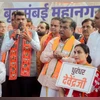 "Maharashtra CM Devendra Fadnavis at an event to celebrate the BJP's victory in the state's municipal corporation polls (Photo: PTI)")
premium
Maharashtra CM Devendra Fadnavis at an event to celebrate the BJP’s victory in the state’s municipal corporation polls (Photo: PTI)
5 min read Last Updated : Jan 18 2026 | 11:20 PM IST
Listen to This Article
Addressing a rally while campaigning for elections to the 29 municipal corporations in Maharashtra, Chief Minister Devendra Fadnavis said infrastructure works worth nearly ₹2 trillion were underway across the Mumbai Metropolitan Region (MMR) — one of the most urbanised belts in India with 9 municipal corporations.
In the results that came in on January 16, the Bharatiya Janata Party (BJP), along with allies, won the country’s richest civic body, the Brihanmumbai Municipal Corporation (BMC) — effectively ending a three-decade run by the Thackeray family, despite cousins Uddhav and Raj joining hands after sparring for two decades in a bid to consolidate the Marathi votes.
Apart from BMC, the BJP-led Mahayuti also commands a majority in 22 other civic bodies.
According to some experts, the helming of the BMC by a national political party that is also in power at the Centre may fast-track execution of big-ticket infrastructure projects.
“Urban areas contribute overwhelmingly to the national income: About 65 per cent. The commissioners for the MMRDA and the BMC are generally handpicked by the CM. When there are different power centres at the BMC and the state level, the natural reflex of the bureaucracy is to stall and procrastinate. The moment big projects get postponed, there is cost escalation. Now, with the same party at the Centre, state, and the BMC, the government will be able to negotiate with the multilateral agencies to get loans for mega projects in the MMR,” says Abhay Pethe, former economics professor at the University of Mumbai and senior fellow at the Pune International Centre.
However, there are challenges ahead as well, according to Pethe, which include Mumbai’s high realty prices pricing out investors. “Any city has to be livable and take care of livelihoods. Jobs are not going to come too easily, especially in the age of artificial intelligence (AI). The key thing is to ramp up skills and encourage startups. The job of a local body is to build infrastructure and attract investment so that the growth cycle kicks in,” he says.
According to a source in the state bureaucracy, several projects are set to gain momentum once the new government assumes charge of the BMC. In the offing are geographic information system (GIS) mapping, survey and redevelopment of slums through the Slum Rehabilitation Authority (SRA); more tunneling projects; and AI-led approvals for new buildings. However, the source added the same party being in power at the state-level may lead to more centralised decision-making at the cost of a consultative approach.
The Mahayuti will have to cater to a cross-section of voters across the economic strata, according to Kedar Naik, assistant professor at Pune’s Gokhale Institute of Politics and Economics. “The voting pattern suggests that the BJP-led coalition synthesised the demands of all economic constituencies: Middle classes, urban poor, and elite. For the middle classes, they will have to deliver on road expansion, beautification, and infrastructure projects. For the urban poor, they need to ensure housing, slum rehabilitation, and welfare. Some centrally-sponsored schemes will help in this. For the elite, they will have to speed up land permissions, business approvals and work on floor space index (FSI) liberalisation,” he says.
“Municipal corporations have legacy lands in central business districts that need to be monetised so that they can invest better into urban infrastructure. This can be achieved by tapping into municipal bonds,” Naik adds.
The Opposition, meanwhile, points to the “failed track record” of the ruling alliance.
“Look at their track record on managing state finances. They were supposed to hike the assistance under the Ladki Bahin scheme. What happened to that? Now they are asking for KYC and lakhs of beneficiaries stand excluded,” says Bhai Jagtap, MLC and former president of Mumbai Congress. “Dharavi (slum redevelopment) and Bandra Reclamation projects have been handed over to an industrialist. There will be rampant privatisation,” he adds.
The Ladki Bahin scheme was rolled out by the BJP-led coalition before Assembly elections in 2024. It provides monthly aid of ₹1,500 to eligible women beneficiaries. The state government had promised to hike the amount to ₹2,100 per month.
“Ladki Bahin is becoming a burden on the exchequer. The government has cut down on scholarships for disadvantaged sections and welfare schemes in education. Contractor dues of about ₹80,000 crore are pending on completed works,” says Bhausaheb Ajabe, general secretary, Maharashtra Pradesh Congress Committee.
Echoing the concerns over similar welfare schemes, Sanjeev Chandorkar, former faculty of infrastructure and finance at the Tata Institute of Social Sciences, Mumbai, says: “Income-generating activities need long-term plans. Short-term plans like Ladki Bahin are unsustainable. About ₹48,000 crore is being spent on the scheme. It is increasing the indebtedness of the Maharashtra government, which stands at around ₹10 trillion now. About 20 to 25 per cent of the state Budget is spent on payment of interest on these outstanding loans.”
During the campaigning for the civic polls, Fadnavis had announced expansion plans for Mumbai metro and declared that the state government had placed a demand for 238 new rakes to convert local trains into air-conditioned services.
Chandorkar adds a note of caution to promises like these: “The question is what price is being attached to the services that are being provided. The ‘publicness’ of public infrastructure is key. In the third phase of Metro, the to and fro ticket at some locations is almost ₹100. In a city, which is home to a huge informal sector, isn't this price too high?”
Cracks in the Opposition
A senior office-bearer of the Congress said the Nationalist Congress Party (SP) has emerged as the weakest link in the Maha Vikas Aghadi. According to him, the Shiv Sena (UBT) and the Congress are the two “strong pillars” of the Opposition coalition, but the fear was that the two NCP factions may eventually reconcile — they had joined hands for elections to the Pune and Pimpri-Chinchwad municipal corporations.
Topics : Mumbai BMC Politics Election news