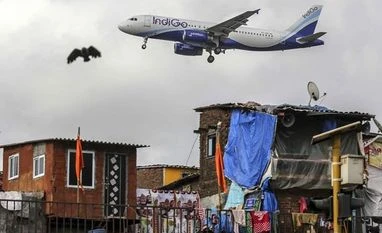
Currently, IndiGo has a fleet of about 304 aircraft. The firm’s fleet management has been its absolute bedrock in building a successful, cost-efficient airline operation, which has got a shot in the arm with the latest order for Airbus A320neo, A321neo, and A321XLR (extra-long range) aircraft, observe analysts.
“This order highlights the continuation of the low-cost business model for IndiGo even in the international segment, which should result in consistent cost expectations. The A321XLR will offer an extended range deeper into Europe and East Asia,” writes Ansuman Deb of ICICI Securities, in a note co-authored with Ravin Kurwa.
The brokerage has set a one-year target of Rs 3,000 on the stock — roughly 20 per cent higher than the record high level of Rs 2,499.95 it hit in intraday trade on Tuesday. The stock ended the day at Rs 2,438.35. IndiGo has been able to successfully manage its fleet by ensuring a continuous increase in capacity, along with the benefits of associated cashflow, consistently maintaining a uniform and fuel-efficient fleet composition, and operations on its single-aisle aircraft fleet, regardless of the strategy of increasing the international mix to 30 per cent over the next two years and 40 per cent by this decade.
IndiGo’s consistent approach to aircraft management, say analysts, has given it a rich dividend by continuously being able to sustain cycles in terms of lowest cost structure and cash accretion. The latest order will be delivered between 2030 and 2035. The engine selection for this order will be done in the fullness of time, as will the exact mix of the A320 and the A321 aircraft. “The A320neo family of aircraft will help IndiGo lower its operating costs and deliver fuel efficiency with high standards of reliability. It will also help with its sustainability goals, with the company having already realised a carbon reduction of 21 per cent in 2015-16 through 2022-23,” reads a note by Motilal Oswal Financial Services.
Global brokerage Morgan Stanley has maintained its ‘overweight’ rating on the stock after the acquisition, with a target price of Rs 3,126, as it believes the order will help perk up market share and profit margin in the near term. In May 2023, IndiGo recorded its highest-ever market share of 61.4 per cent, capitalising on Go First suspending flights. It last crossed the 60 per cent mark in July 2020. Data from the Directorate General of Civil Aviation shows IndiGo having flown more than 8.1 million passengers, of a total of 13.2 million, last month. In the first four months of 2023, IndiGo registered a market share of 54–58 per cent. IndiGo operates about 1,600 domestic flights every day, which is 58 per cent of all flights in the country.
Financially, InterGlobe Aviation logged a net profit of Rs 919 crore in the January-March quarter of FY23. It, however, reported a net loss of Rs 316.7 crore for FY23. Core debt stood at Rs 3,300 crore as of March 31, 2023, while cash balances were Rs 23,400 crore. The airline’s passenger (pax) growth was 71 per cent year-on-year (YoY) in FY23, with the pax load factor rising 800 basis points to 82 per cent, and a 21 per cent jump in yields. IndiGo’s management has guided for available seat kilometre (ASK) growth of 17-18 per cent YoY for FY24, while the first quarter of FY24 is expected to increase by 5-7 per cent quarter-on-quarter. The pax target is 100 million.
ASK is a measure of an airline’s carrying capacity to generate revenue, taken from multiplying the available seats on any given aircraft by the number of kilometres flown on a given flight.


 "IndiGo")

